The Road to Antarctica Begins in Buenos Aires
Buenos Aires, Argentina
After a long and anxious visa process, we finally spent three days discovering Buenos Aires before continuing south to Antarctica.
Across the Drake Passage to Antarctica, with landings, whales, penguins, a blizzard, and one final flight delay.
January 12–25, 2025 · Buenos Aires · Ushuaia · King George Island · +1 · 4 entries
Buenos Aires, Argentina
After a long and anxious visa process, we finally spent three days discovering Buenos Aires before continuing south to Antarctica.
Ushuaia, Argentina
After choosing a ship, planning the route, and weighing the prospect of the Drake Passage, we finally boarded our expedition vessel in Ushuaia.
King George Island, Antarctica
We crossed the punishing Drake Passage, then landed in Antarctica to see seals, penguins, and whales, climb through deep snow, kayak among ice, take a polar plunge, and finally meet a blizzard.
Puerto Natales, Chile
After a nearly 40-hour delay to our flight out of Antarctica, we rebooked our journey from the ship, entered Chile at Puerto Natales, and finally began the long trip home.
After a long and anxious visa process, we finally spent three days discovering Buenos Aires before continuing south to Antarctica.
Our journey to Antarctica began in the capital of Argentina.
By long-established international custom, every international trip begins with a visa. This time, the Argentine visa process handed me a particularly large complication.
Under the rules in effect when we applied, Chinese passport holders with a qualifying US or Schengen visa—and visas from several other countries—could use a simplified entry arrangement. A US green card, however, did not qualify. I found this baffling. A traveler with a US visa was apparently not considered likely to remain in Argentina, while a US permanent resident might be? From my perspective, the distinction made no sense.
Rules were rules, so I needed an Argentine visa. The application itself was not especially complicated. It required the familiar collection of travel plans, hotel and flight bookings, bank statements, and similar documents. The difficulty was timing. In our case at the time, applying through the Argentine consular system in the United States meant that we could not submit until roughly ninety days before the trip. Our flight would arrive on January 12, 2025, so the first practical filing date was a business day after about October 14, 2024.
That alone would have been manageable. What we found online at the time suggested that applicants in China could apply earlier and might receive visas valid for six months or even a year. In the United States, we could apply only ninety days ahead, and the visa itself was valid for entry for exactly ninety days from its date of issue—not a day more or less. That probably explained the filing restriction: apply too early, and the visa could expire before the journey began. We seriously considered returning to China to apply. The documents were submitted online and an interview might not be necessary, so perhaps no one cared where we physically were. After reviewing the requirements, however, we found that applying there would require Chinese income and bank documentation that was even more awkward for us to provide. We abandoned the idea.
There was another complication: Argentine consulates across the United States appeared to have very different working styles. Each had its own website, and online accounts described some as fast and others as slow. The Los Angeles office serving California was singled out for particularly severe criticism. The office in Illinois was said to be unusually quick. We even seriously considered listing a friend’s Illinois address to see whether we could apply there, though we never acted on the idea. In the end, I had emailed that office and received no response for two months. I remained unconvinced by its reputation for speed and decided not to complicate matters further.
We applied through Los Angeles. Its pace was exasperating. The email acknowledging our documents was automated and said to expect a reply in five to ten business days. Ten business days passed without one, so I wrote again. Another automated response now advised waiting fifteen to twenty business days. Five more days passed; I sent another message and received the same automation, this time promising twenty to twenty-five business days. It also added that applications submitted after November would not be processed until the following year.
From where we were sitting, an entire month had passed without the application moving at all. No matter when I wrote, the expected wait simply stretched another ten days into the future. The online accounts we had read—of an exceptionally slow consulate issuing visas so close to departure that travelers nearly had to change their flights—were beginning to feel entirely credible.
This continued until roughly the end of November. We were deeply anxious and had no useful way to intervene. Email produced only meaningless automated replies. Reaching anyone by telephone seemed to require a minor miracle.
At the end of November, the consulate finally emailed to arrange an online interview in early December and asked when we were available. There was nothing to consider: we were available whenever they wanted. Name the time and I would take leave from work if necessary. Who knew what fresh complication might appear if we delayed?
I can only say that we were fortunate to have submitted on the first business day we were eligible. Had we waited until November—which would have meant postponing the application by only about two weeks—the entire Antarctic journey might genuinely have been cancelled.
On interview day, another complication duly arrived. A half-hour interview began thirty-four minutes late. This time we were less alarmed because it was a WhatsApp video call and we already had the interviewer’s contact. Ten minutes after the scheduled time, we sent a very polite message whose underlying question was essentially, “Where are you?” Predictably, there was no response. Persistence eventually paid off: after waiting in place, we finally reached the interviewer. He said the previous interview had run long. Fine. He controlled the visa; we were hardly in a position to negotiate.
The interview itself went smoothly. Our application was fairly complete. Comparing it with the checklist, the interviewer said we needed only two additional documents. We had already submitted similar material and thought it sufficient, but now he specified exactly what he wanted. He also helpfully told us not to wait for acknowledgment of the new documents before mailing our passports. We could send them immediately and let both processes proceed in parallel. That is what we did.
The brief interview ended, and we emailed the requested files at once. We promptly received another automated reply recommending a wait of twenty-five business days. There was no way to know whether anyone had actually received them.
The next stretch was even more nerve-racking, because now we no longer had our passports either. In the end, the documents had indeed arrived. Roughly two weeks after mailing the passports, we received them back with fresh Argentine visas attached. It was already December 23, less than three weeks before departure.
The lesson would seem to be that an Argentine visa application should begin as early as possible; delay could be disastrous. On reflection, that advice is probably useless to most readers here. Chinese readers applying in China could start much earlier, while American readers did not need a visa at all.
In any case, the journey went ahead.
Why begin in Buenos Aires? Ships to Antarctica departed from Ushuaia, and flying there from the United States inevitably involved a connection in Buenos Aires. This was more than the recurring logic of “we have come all this way, so we may as well look around.” Many of the connections we found for our itinerary involved changing airports in Buenos Aires. Yes, the city has more than one airport. They were not enormously far apart; without traffic, the drive was on the order of a few dozen minutes.
Given that arrangement, we had already come this far…
Our Antarctic itinerary also began on a Wednesday, which meant leaving the United States no later than Monday around midday. We would have to take the entire week off regardless. Why not depart on the previous Friday evening instead? The same amount of leave would buy us more time in Argentina. Once the vacation days were committed, we might as well use them.
All told, including arrival day, we spent three days in Buenos Aires.
We arrived at midday. At immigration, Argentina immediately gave us another taste of just how relaxed things could feel here. The immigration officer processed our entry while watching something on his phone—and he was genuinely absorbed in it. Something about our passports apparently required further checking. He took them into a back office and told us to wait where we were. As he walked away, he carried the passports in one hand and his phone in the other, continuing to watch the video. I had visited more than twenty countries by then, but this was a first.
Entry itself went smoothly. Whether the phone prolonged our wait was another question, but there were no actual problems. He returned from the back office and admitted us immediately.
We then took an Uber from the airport to the hotel. The driver managed to surprise me again: he used his phone while driving. There was little I could say beyond the obvious—whatever else one might think, keeping one’s eyes on the road seems like a fairly basic requirement.
After resting at the hotel for the afternoon, we booked a tango dinner that evening. The concept was simple: we ate dinner in a small venue while tango was performed on stage. Browsing Viator, I found that dinner-and-tango shows were among the most popular activities in Buenos Aires, with a great many providers. I chose one more or less at random.
I have no particular assessment of the dinner; it was an ordinary meal. The tango, however, must have been reasonably authentic Argentine tango. If a performance this commonplace in Buenos Aires did not qualify, I was not sure what would.
On our second day, we took a full-day tour of Buenos Aires’ popular sights. Before the trip, we had read online that Buenos Aires could be quite risky, with motorcycle or scooter snatch theft among the incidents travelers reported. We therefore bought phone tethers and strapped our phones to our wrists. The dark joke was that, if a rider tried to snatch one, either the phone stayed or the hand went with it. Our guide also warned us that, however safe the streets might appear, we should avoid displaying anything valuable. Carrying a DSLR openly in one hand, for example, was precisely the sort of invitation a thief might notice. Fortunately, no one tried to rob us that day. Whether we were lucky or conditions had improved, I could not say.
Perhaps the most famous stop was Caminito. Its name means something like “little path” in Spanish.
We also visited this bookshop in central Buenos Aires. We tried to find a Spanish-language edition of One Hundred Years of Solitude to bring home for a friend. Unfortunately, our Spanish was too poor and we never located it. I would imagine the shop probably had a copy somewhere.
On the third day, we visited a ranch outside Buenos Aires for a full-day countryside excursion. To be honest, the itinerary felt rather thin. I spent most of the day either sitting in a vehicle or waiting without much to do. We did see an impressive equestrian display, beginning with a rider facing backward on the horse—a fine demonstration of harmony between human and animal.
The performance gave me a useful new standard. From now on, whenever someone tells me they know how to ride, I know exactly what demonstration I am going to ask for.
That concluded our time in Buenos Aires. Next came a flight to Ushuaia, the end of the world.
After choosing a ship, planning the route, and weighing the prospect of the Drake Passage, we finally boarded our expedition vessel in Ushuaia.
We had reached Ushuaia. The journey to Antarctica was about to begin.
Antarctica. I had been thinking about this trip for years. Long before we went, I had read that expedition berths were notoriously difficult to secure and generally needed to be booked about a year in advance. I eventually made our reservation the previous April. Why April? Because until then I had been occupied with Egypt, and the third-party tour listings I was watching continued to show availability. I assumed I could simply book after I returned.
That was when I learned how naive I had been. Of course those travel-agency listings continued to show space: they were third-party sales pages, and their inventory did not update automatically. The sites even said explicitly that customers should contact them before placing an order. If the voyage was full, an agent could simply say so. Whether I actually secured a berth was hardly the website’s problem.
I understood all of this only after spending considerable time in April researching how Antarctic travel worked. The first decision was the expedition company. Some companies operated their own ships all the way to Antarctica, which meant there was no need for another intermediary. I could not shake the feeling that adding a middleman to a trip whose least expensive berth already approached US$10,000 would only make an expensive journey cost even more.
There were still quite a few operators to compare, and the advice quickly became overwhelming. Antarctic landings involve matters such as site capacity, passengers going ashore in groups, and the scheduling of Zodiac boats. In broad terms, the larger the ship and the more passengers aboard, the more constrained landing operations tend to become. A larger vessel is generally steadier and less likely to induce seasickness, but may leave less time ashore; a smaller vessel tends toward the opposite trade-off. The staffing ratio also matters. With too few expedition staff, guides, and crew for the number of guests, service can suffer—an important consideration when the ship will be home for many days. Then came ratings for every other conceivable detail. The more I read, the less simple the choice appeared.
In the end, I trusted the recommendation in one article and chose Lindblad Expeditions. It was said to be relatively expensive, but also highly professional and known for excellent service. One factor carried disproportionate weight with me: the company had a longstanding collaboration with National Geographic, and the program was called National Geographic-Lindblad Expeditions. I knew almost nothing about Antarctic expedition companies, but I knew National Geographic. That familiar name was reassuring enough.
After choosing the company, we had to choose a departure. There were many dates, roughly one each week, but the itineraries were not identical. Some voyages sailed from Argentina and returned there by ship. Others ended with a flight to Chile. Still others began and ended in Chile, using flights in both directions.
What we had heard at the time was that the Drake Passage between Argentina and Antarctica could be formidable, and was often described as one of the world’s most dangerous stretches of sea. A glance at the map helps explain its reputation. The passage lies between South America and Antarctica, along a confined ocean corridor traversed by the Antarctic Circumpolar Current. The high southern latitudes also experience powerful westerly winds, sweeping around Antarctica with little continental landmass to obstruct them. Strong current, persistent wind, and ocean swell combine to give the Drake its famously rough conditions.
I am severely prone to seasickness, so I would have avoided the passage if possible. By the time I booked, however, the fly-both-ways option had no availability on dates that suited us; the alternative was to wait until late February, which we ultimately decided against. A round-trip voyage by ship was two days longer than sailing south and flying back, and cost several thousand dollars more. The less expensive choice was obvious to me, and there seemed little reason to put myself through the Drake twice. We therefore chose to sail to Antarctica and fly back to Chile.
That decision meant I needed an Argentine visa. Had we flown both ways through Chile, I would have been eligible to enter Chile without a visa under the rules that applied to my circumstances at the time—a Chinese passport together with a U.S. green card.
The Argentine visa process had already provided more than enough trouble, as described in the previous entry, so I will not repeat it here.
After overcoming all of those obstacles, we finally arrived in Ushuaia. The expedition staff met us and took us to the hotel, where they promptly “took possession” of our passports. In less dramatic terms, they temporarily collected them to complete the necessary travel and expedition formalities.
At the welcome dinner that evening, our guide introduced himself with suitable ceremony: Michael Jackson. In his own words, this was not a joke; that was genuinely his name. When he was born, the singer Michael Jackson was still an infant himself, so his name clearly had nothing to do with the Michael Jackson who would later become a global star.
The next day, we visited a nearby national park. To be honest, the outing was fairly modest.
We then visited Ushuaia’s well-known Les Éclaireurs Lighthouse.
We could already see many penguins on the island, and our fellow travelers were visibly excited. None of them could have guessed that, within a couple of days, we would see what felt like dozens of times as many.
That evening, we boarded the ship that would carry us to Antarctica: the National Geographic Explorer.
The Antarctic journey had officially begun.
We crossed the punishing Drake Passage, then landed in Antarctica to see seals, penguins, and whales, climb through deep snow, kayak among ice, take a polar plunge, and finally meet a blizzard.
After we boarded, the ship did not leave port. The wind and seas were too severe for the Drake Passage. Based on what we were told at the time, waves on a typical crossing averaged around five meters. Conditions below ten meters might still be considered; once they exceeded ten, departure was essentially out of the question. That was the situation that evening. We had been scheduled to sail immediately, but departure was postponed until the following day.
Passengers were therefore allowed to go back into Ushuaia for the evening, provided they returned before midnight. We stayed aboard. We genuinely had no idea what else there was left for us to do in Ushuaia. Apparently, quite a few people went into town for the bars.
By the next morning, the passage was still closed to us. It was deeply frustrating, but there was nothing to be done. It felt as though our Antarctic journey had lost an entire day before it had even begun—a painful bargain at these prices.
That afternoon, the captain finally announced that we could depart. At five o’clock, accompanied by one long blast of the ship’s horn, we left the harbor and headed toward the Drake Passage.
At seven that evening, I even took a shower. We had not yet fully cleared the channel south of Ushuaia, and the water remained relatively calm. I had no idea how serious matters were about to become. I simply went to bed.
Sometime after midnight, I woke to metallic clanging in the cabin, as though something were rolling back and forth across the floor. It was the metal water bottle we had been issued. Despite sitting on a shelf with a guard rail, it had escaped and was roaming the room. Fortunately, I could reach it from the edge of the bed without standing up. I put it in my bag. Realizing how violently the ship had begun to move, we took our seasickness medicine and went back to sleep.
The following morning, when I tried to get out of bed, everything fell apart. We were told the waves were around six meters that day—roughly average by the standards of the crossing. For me, they were already far too much.
I sat up. I lay back down. I sat up again, then lay down again. After several rounds, the attempt to get up was officially abandoned. The instant I sat upright, I became dizzy. Within seconds, nausea followed. There was nothing to do but lie flat. The seasickness tablets we had brought did nothing. We also applied the motion-sickness patches we had packed. Those did nothing either. We remained profoundly seasick.
We began to wonder whether our medicine was simply too weak. Someone had to volunteer for the doomed expedition to the reception desk on our deck and ask for stronger medication. That someone was me. I walked for a little over ten seconds, stood for five seconds while asking for the medicine, and walked the ten seconds back. The first thing I did upon returning to the cabin was rush to the toilet and vomit. It was the first time I threw up on this journey, but not the last.
I felt slightly better afterward, but I still had to remain horizontal. Getting up meant immediate disaster. We took the medicine supplied by the ship, and it too seemed useless. My tolerance for seasickness was apparently so poor that no remedy could save me. As I experienced it, lying down was almost fine. I could feel the ship moving violently and could readily imagine why I had just been sick, but as long as I stayed flat, the problem remained manageable. The moment I sat up, the feeling returned. I could last perhaps a minute before needing to vomit. Standing reduced that to thirty seconds at most.
So we lay in the cabin, incapable of doing anything. We missed breakfast, and then we missed lunch. A new problem emerged: lying down kept the nausea under control, but now it felt as though our blood sugar was dropping. There was no choice. We had to call for help.
I moved to the chair beside the telephone and called the ship’s doctor. She asked whether I could make it over. I told her there was absolutely no possibility of that; she would have to come to me. She said she would be there shortly. I somehow completed the call during the minute I could tolerate sitting, then went back to the bathroom to vomit again.
I returned to bed, and the doctor arrived a few minutes later. After seeing the situation, she said, in effect, that there was not much else to do except give an injection of seasickness medication strong enough to induce sleep through the Drake Passage. Many people aboard were ill on this crossing, she added, and the supply was nearly exhausted. Luckily, there was still some left.
After the injection, I was asleep before long.
When we woke the next day, the ship had largely cleared the Drake Passage and officially entered Antarctic waters. The most obvious difference was that the seas were calmer.
We decided we were functional again and tried getting up. To be fair, “calmer” did not mean calm. The seasickness had eased considerably, but the symptoms had not disappeared.
We went to breakfast. We had gone far too long without food. Since the evening before last, all I had managed was two crackers eaten while lying in bed the previous day—and I had thrown up a fair portion of those. If I did not eat now, starvation felt like the next item on the itinerary.
On the way to the dining room, we discovered ropes everywhere throughout the ship. At first, we did not understand their purpose. Then we reached the restaurant and found it webbed over with ropes, with passengers holding on as they moved around. So that was what they were for. We also noticed hooks beneath the tables and chairs. Ropes had now been attached to them, securing the furniture to the floor. During our first two days of meals aboard, everything had stood loose. The weather had clearly become serious. Even as we ate, the ship continued to roll, and from the kitchen came repeated bursts of crockery colliding. We could only hope nothing had broken.
We endured breakfast and returned alive. Naturally, our first action was to lie down again. Seasickness behaved like a progress bar in a game. Moving around caused the meter to rise; lying down made it fall. If it reached 100 percent, it rapidly emptied itself—in other words, I vomited.
By noon, the seas had eased further, allowing us to stay up longer and roam a little farther. By afternoon, the water was nearly calm, and we had reached Antarctic waters. I had never expected Antarctica itself to be the calmest place in the region.
Only later did we learn that several formidable passengers aboard scarcely suffered from seasickness at all. They had ventured out during the worst conditions the day before, and someone took this photograph in the lounge.
The motion had been strong enough to send the ship’s grand piano flying. One would think a piano aboard a vessel should be secured to the deck. Were they really reenacting The Legend of 1900 and allowing it to wander about at will? Or had it actually been fastened down, only to be thrown loose anyway?
This was our complete itinerary.
To my eyes, many of these places looked remarkably alike, and I had no idea how to distinguish them afterward, so I have combined them here. The “whale-watching points” on the map were not precise locations either. They were areas at sea where whales might appear; an encounter happened whenever it happened.
We lived aboard the ship, but visiting Antarctica required what felt like an amphibious landing. That description is scarcely an exaggeration. These were the landing craft we used: Zodiac inflatable boats.
For a landing, the larger ship stopped offshore and opened its side door. We descended directly into the Zodiacs. There was no pier at the “shore”—if shore was even the right word—only a completely natural coastline. Staff went ahead to install temporary aids, such as plastic steps. The Zodiacs then approached the beach, we stepped from the boat into shallow water onto those steps, and from there walked ashore. It truly felt like a beach-landing operation.
An Antarctic landing is not a matter of sailing until the scenery looks appealing and stepping ashore. Most Antarctic expedition cruise operators belong to IAATO, the International Association of Antarctica Tour Operators, and vessels coordinate landing sites and times in advance to avoid crowding the same place. Generally, only one vessel lands at a given site at a time, and no more than 100 visitors may be ashore. A ship carrying two or three hundred guests therefore has to divide them into groups. A common arrangement is for one group to land while another cruises in Zodiacs, after which they exchange places.
Individual sites also have their own rules. Some accept only one or two ships per day; some limit the duration of visits. Certain areas are closed to protect penguins, seals, or vegetation, while historic sites may restrict how many people can enter at once. Ships carrying more than 500 passengers cannot land passengers and are limited to cruise-only operations.
The shipping company and expedition team handled most of this scheduling and coordination behind the scenes, so ordinary passengers rarely noticed it. Each evening aboard our ship, Michael Jackson told us where we hoped to go the next day. Antarctic weather and sea ice change rapidly, however, so even a reserved landing could be canceled or replaced at short notice. Put simply, Antarctic landings meant scheduled times, one ship at a site, no more than 100 people ashore, and whatever additional rules applied to that particular location.
For each landing, we wore tall waterproof boots, waterproof trousers over our regular clothes, down jackets, and life jackets. We were equipped from head to toe. Environmental controls in Antarctica were strict, with great care taken not to carry organisms or pathogens from one landing site to another, particularly on footwear, clothing, or equipment.
If our boots stepped in anything at one site—most often penguin droppings—they had to be scrubbed clean before we could reboard. Staff helped with the cleaning. Clothing and equipment were also supposed to remain free of soil and biological residue; anything contaminated had to be cleaned upon returning to the ship. The expedition even supplied trekking poles. Because their tips touched the ground, those too had to be scrubbed afterward.
Our expedition team was as professional as advertised and followed the rules rigorously. During the voyage, however, we encountered another vessel landing seemingly at will. Our guide said that our ship had reserved the site and that he had not seen any arrangement for another vessel to be there at the same time, so he believed they were probably violating the landing plan. In the spirit of everyone doing their part for environmental protection, our group reported them.
At our first landing site, I saw large numbers of seals. They behaved rather like a pack of wolves. They would be lying lazily on the ground, perfectly content, until one began calling. Several others would immediately join in, raising their heads and howling toward the sky. We were told they were competing for dominance.
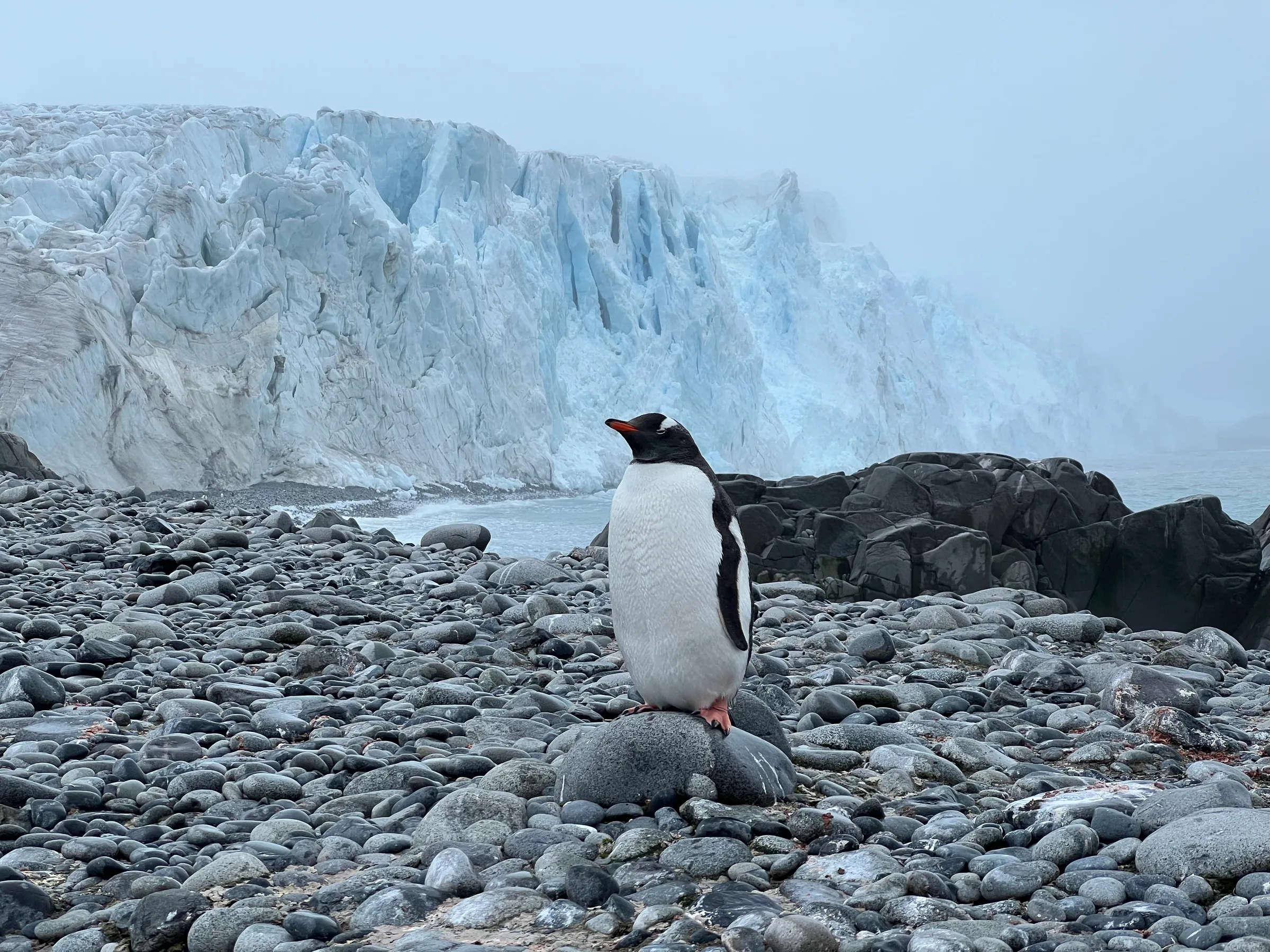
At subsequent landings, penguins began appearing in great numbers.
This was my first portrait taken in Antarctica.
Anyone who has watched a penguin defecate knows that the result is remarkably forceful: a thin white line shoots out behind it, tracing a graceful—if that is really the word—parabola. Now the white lines around the nests make sense.
I also recorded an excellent video of penguins fighting. Video is less convenient to publish here, however. Perhaps next time—which is what one always says.
We also went out in Zodiacs to observe whales at close range. Encounters depended entirely on luck. Whether we found any whales at all was uncertain. The larger ship adjusted its course according to where whales had been seen and moved toward areas they frequented, which became the customary whale-watching zones. Even there, luck determined how close an animal might come.
Our luck was exceptional. As our boat moved slowly along the whales’ direction of travel, one swam beside a Zodiac ahead of us and began circling it.
We were still remarking on the extraordinary luck of the other boat when the whale came directly toward ours. It surfaced beside us, less than two meters from the edge of the boat. Its fin rose above the water so close that it seemed almost within reach.
I recorded a video filled with the exclamations of everyone aboard. The final image above is a frame from that footage, hence its lower clarity.
In retrospect, watching a whale from such close range may have been rather dangerous. This was “only” a humpback, yet it measured more than twelve meters. Our Zodiac could not have been more than six meters long. One careless flick of that tail looked as though it could have sent us flying. Presumably—perhaps—there had not been such an incident before.
We also saw orcas from the larger ship, many times.
During one landing, we climbed a mountain. The ascent felt exhausting, only for us to learn afterward that the summit stood just over 200 meters high. When I told friends about it, their immediate response was that 200 meters hardly qualified as a mountain. Was that not simply an oversized mound of earth?
Under normal circumstances, they would have had a point. Antarctica was not a normal circumstance.
First, this was the panorama from the summit.
I took the obligatory summit photographs.
And this was the route up.
As the photographs show, there was no trail in the conventional sense, only a route through the snow. Climbing here required full cold-weather clothing: down jacket, thermal leggings, insulated trousers, everything. Without them, one would freeze. All that equipment multiplied the effort compared with hiking in shorts and a T-shirt. Even setting that aside, the snow track was difficult. For long stretches, the snow reached around thirty centimeters deep. Each step sank in, and simply pulling a foot free required effort. Nor could we tell what lay beneath. A step might land on ice hidden under the snow and send us sliding. Throughout the climb, we had to remain alert, brace our cores, and make sure each footfall held.
By the time I reached the summit, I was exhausted. About fifty people had set off behind Michael Jackson at the start. Only four remained with him when we reached the top. After we took photographs and began descending, many others gradually arrived. Early in the climb, the guide’s advice had been, “You are nearly there—keep going.” Farther back, it had changed to, “You should turn around. You may not make it back in time.”
We also visited several historic remains in Antarctica. Our guide offered an amusingly simplified description: anything left before 1958 counted as a historic artifact, while anything left afterward counted as rubbish. His explanation was that Antarctic activity changed dramatically around the International Geophysical Year of 1957–58. Huts, equipment, and objects from the early era of exploration might possess historic value. Waste left after the later expansion of scientific stations, however, did not automatically become heritage merely because someone had abandoned it in Antarctica; in principle, it should be removed under environmental rules.
In Antarctica, then, when one abandons rubbish matters enormously. Leave it early enough, and yesterday’s waste may become today’s treasure.
Penguins had already occupied some of the remains.
Other buildings had not yet fallen to the penguin advance.
By any reasonable standard, this building looked structurally suspect. The guide said we were welcome to go inside and look around, but if it collapsed, that was our problem—a warning delivered more as dark humor than legal language. I went in. Fortunately, I supposed Antarctica had no termites and relatively few earthquakes; otherwise, the place might have fallen long ago.
The ship also organized polar activities, including kayaking and a polar plunge.
The kayaking sounded particularly appealing: a two-person boat among fragments of ice in Antarctic waters. It was difficult not to be excited.
The activity depended heavily on weather, largely because Antarctica left little margin for error. Our guide said we could go to the proposed area and proceed if conditions allowed; otherwise, we would have to abandon the plan. We arrived to find excellent weather. The answer was obvious: launch the kayaks.
Calling it an activity site was generous. It was simply a stretch of water beside the Antarctic continent. The location was probably chosen because its geography made calm conditions more likely. That day was clear and windless, ideal for kayaking. Staff went out first, marked a broad area with buoys, and told us not to paddle beyond the boundary. Then we could leave the ship.
This was our kayak.
And this was what it felt like to paddle into the broken ice ourselves.
Naturally, we took photographs.
Then came the polar plunge. A temporary jumping point was assembled near the kayaking area. In practice, two Zodiacs were positioned beside the open door of the larger ship, with a plastic platform of less than ten square meters suspended roughly one meter underwater between them. Participants stood on the bow of a Zodiac, jumped into the sea, swam to the platform, stood up, climbed back into the Zodiac, and returned to the ship.
That was the procedure for people who could swim. Those who could not were allowed to launch themselves directly onto the plastic platform. As long as the entire body went into the water, the attempt counted.
The activity sounded appropriately dramatic. Predictably, I had to sign two additional waivers—documents that felt very much like contracts surrendering one’s life. The plunge was clearly unwise for anyone with conditions such as high blood pressure or heart disease, yet roughly seventy of the ship’s more than 140 passengers participated. As far as I could tell, people around my age were exceptionally rare aboard, perhaps fewer than ten. Nearly everyone was at least ten years older than I was, many more than twenty years older, and gray hair was common. These explorers in their fifties and sixties were genuinely formidable.
The seawater was about 2°C. I had assumed the jump itself would be the worst moment, but it was not. Entering the water happened in an instant, and the entire interval before reaching safety lasted no more than twenty seconds. One simply endured it. Waiting in line was far worse. We stood in the Antarctic wind wearing only swim trunks. Even that was tolerable for a few minutes. At the beginning of the queue, we could wear sandals, but beside the Zodiacs we had to leave them aboard while several people still stood ahead of us. Towels covered the ground there, but they were saturated with icy water. I stood on them barefoot for two minutes and nearly lost all feeling in my feet.
In the end, I completed the plunge. Unfortunately, there is no photograph to prove it.
Back aboard, the doctor stood nearby and handed each participant a special warming coffee. I did not catch a cold, and everything remained normal.
The landscapes seen from the ship were as remarkable as those at the landing sites. An old line of verse came to mind: with the clouds dispersed, moon, sky, and sea needed no further ornament. The clarity of the blue water and open sky was difficult to rival.
Beyond the scenery, life aboard was impressive in its own right. The ship was remarkably luxurious. The lounge bar opened every afternoon and stayed open indefinitely into the evening—as long as someone remained, it remained open—with all drinks included. My only disappointment was that one nonalcoholic drink I had selected remained out of stock until I disembarked. It had looked delicious, which apparently meant everyone else had reached the same conclusion first. The ship also had a sauna, a spa, and a glass-walled panoramic gym. The range of facilities was extraordinary.
Eventually, our journey approached its end. The ship returned to King George Island, where an airport would provide our flight to Chile.
Naturally, something went wrong again.
The airport was rudimentary and bore little resemblance to an ordinary civilian terminal. The runway did not look like a conventional paved surface; from what I could see, it was made entirely of gravel. Taking off and landing there appeared difficult. With minimal facilities and rapidly changing Antarctic weather, flights depended heavily on visibility and conditions. The sky had to be clear, or visibility had to exceed some required distance, before an aircraft could operate.
Our guide said that, in their experience, the usable flight window on a given day might last only a few hours. We therefore spent our final day aboard waiting. Once a window was confirmed, we would take Zodiacs to the island and proceed to the aircraft.
On our scheduled departure day, no window opened at all. Observations at the time also suggested that flying might remain impossible the following day. We should ordinarily have continued waiting, but because operations were definitively impossible for the moment, the captain arranged one more landing. We gained an unexpected additional excursion.
And saw still more penguins.
Attentive readers may notice that these photographs differ substantially from all the earlier ones. Every previous image was taken in fine weather. For several days in Antarctica, both at sea and ashore, we had enjoyed clear skies and excellent conditions. Whether that was fortunate or unfortunate depended on one’s perspective. It made every activity much easier, but it did not feel remotely Antarctic.
This day was different: a full blizzard. The air was cold, the apparent temperature far lower than before, and the wind cut through us. For the first time, Antarctica felt genuinely severe.
Many people aboard expressed the same thought: this was Antarctica. The previous days of sunshine had encouraged the unrealistic impression that the continent was tranquil.
Once back aboard, everyone seemed even more satisfied. We had now experienced an Antarctic blizzard as well. The journey felt complete.
That evening, the guide told us that flight operations would probably be possible the next morning. We should sleep, he said; if a window opened, they would wake us.
At four the next morning, we were dragged from bed. Breakfast followed at speed, then a Zodiac ride to King George Island, another beach landing, and a journey to the airport to await the plane.
As noted earlier, calling the place an airport required some generosity. Around its perimeter stood a few structures that could be described as buildings, and we waited inside until the aircraft was nearly ready to land. We were told that cleaning the facilities was extremely difficult. To protect the environment, we should avoid using the toilet unless absolutely necessary. Whatever we had, we were asked to carry it onward to Chile.
A bus then took us closer to the boarding area, where we continued waiting in what passed for a departure lounge: two plastic tent-like shelters. The wind roared outside, and its howling remained plainly audible through the plastic. At this point, toilets ceased to exist altogether.
The aircraft did finally arrive. One was painted black and white, prompting the guide to call it the penguin plane. When it took off, people nearby became wonderfully excited and shouted, “The penguin is flying!” The old human tradition of inventing one’s own entertainment remained alive and well.
We boarded the second aircraft and flew to Chile.
With that, our Antarctic journey officially came to an end.
After a nearly 40-hour delay to our flight out of Antarctica, we rebooked our journey from the ship, entered Chile at Puerto Natales, and finally began the long trip home.
The difficult journey home began in Chile.
Well, in truth, it had begun much earlier. The complications started the moment we tried to book the tickets.
Flights in South America were remarkably difficult to arrange. Getting to Buenos Aires on the way out had been manageable—it was Argentina’s capital, after all. We had also invoked our usual principle of “since we’re already going to be there” and turned the connection into a two-day stay. That gave us more flights to choose from and made the booking much easier. Had we tried to fly straight through to Ushuaia, even the outbound journey would have been difficult.
On the Chilean side, our connecting itinerary back to the United States had to begin in the small town of Puerto Natales. Our charter from King George Island would first land there on the South American mainland, so that was where the rest of our return journey had to pick up.
And those tickets…
In our online research, we came across some sharply negative reviews of travel sites such as Expedia, including individual accounts from people who said they had booked online only to discover at the airport that no ticket had actually been issued. That sounded both extreme and rather implausible, but the anecdotes were there. They made us nervous enough that we decided to book directly with the airlines.
The Latin American options we could find at the time were mostly on carriers such as Copa Airlines and LATAM Airlines. We checked each of them, then worked through the major American carriers as well, including United Airlines and Delta Air Lines. Eventually, with considerable effort, we found a few itineraries that met our needs.
They all shared one problem: among the routes we found from Puerto Natales to the United States, not one was operated throughout by a single airline. Every itinerary used a Latin American carrier for the portion within Latin America—or, more precisely, outside the United States—and then switched to an American carrier once inside the country.
That was entirely reasonable. These were sold as connecting itineraries, so in theory it should not have presented much of a problem. And yet…
The first warning came when we tried to choose seats. Book through the Latin American airline’s website, and we could not select seats on the American flights; book through the American carrier, and the reverse was true. Since the Latin American portion made up most of the journey, we considered it more important and decided to buy through that airline’s site. Random seats on the domestic American legs seemed an acceptable compromise.
If seat selection had been the only issue, that would have been fine. We skipped it, continued through every page, reached the final step, and tried to pay. The order failed. We tried again and again, in every way we could think of, and received an error every time.
In the end, we had no choice but to book through Expedia after all. We might as well have surrendered earlier and spared ourselves the effort.
That, however, was only the beginning. About four months in advance, we booked the full itinerary: Puerto Natales to Santiago, Santiago to Los Angeles, and Los Angeles to San Francisco.
From the moment we booked it, the schedule never stayed still. On our particular itinerary, something changed about every two weeks. Each adjustment was fairly small—perhaps an hour—but there were so many of them that the schedule gradually became absurd. At first we went online to review and confirm every change. Eventually, we stopped trying to keep track. The one benefit was that, whenever we chose not to accept a change, the system at the time allowed us to modify the entire itinerary without charge.
That turned out to be a lifesaver.
As I described in the previous Antarctica entry, our flight from Antarctica to Chile could not depart as scheduled and was delayed by nearly forty hours. Every onward flight therefore had to be rebooked. The tour operator that ran our ship also offered a flight-booking service, and in circumstances like these, having them manage the connections would undoubtedly have been convenient. I cannot judge the quality because I did not use it, though I have every reason to believe it was good. The price was another matter. Our entire economy itinerary from Chile to the United States cost a little over $1,000; the booking service alone was priced at $500. That was beyond what I was willing to pay.
Once it became clear aboard the ship that our flight would be delayed, we used our free-change option. It was no minor revision: we pushed the trip back by a full day and even changed where we would enter the United States. By then, the timing of the Los Angeles route had become so impractical that there was no reason to remain attached to it.
Rebooking was still far from easy. It worked well online, provided one had an internet connection. Our ship used Starlink. There was free Wi-Fi aboard, but it was essentially unusable; at perhaps three in the morning, with nobody else online, one might just manage to open the Google homepage. Paid access came in several tiers. We bought the most expensive one. It was not excellent, but it qualified as a functioning internet connection.
Then the circumstances changed. Because the flight was delayed and everyone needed to rearrange their travel, the ship opened internet access to all passengers. The result was simple: when everyone had internet, no one had internet. The expedition staff repeatedly announced that anyone who had already rebooked, or did not need to, should please stay offline and leave the bandwidth to those still trying.
At around ten that evening, once we knew the flight would not leave the next day, we began working through the changes. By roughly eleven, everything was done.
We postponed our itinerary by only one day, which was an aggressive gamble. Our thinking was that if we still could not fly the day after next, we would stop trying to predict events, wait until a departure became possible, and then pay to rebook everything at once. The larger problem was that if we could not fly the following day, our ship would have to return to Argentina. At that point, changing the date would no longer be the real challenge. How exactly does one change a flight departing Chile into one departing Argentina?
On the third day, we finally flew to Chile. Those of us already aboard the ship were in reasonably good spirits. Many of the passengers, especially the white-haired retirees, appeared entirely unconcerned; they would have been delighted to spend a few more days in Antarctica. The captain had even arranged an additional landing on our bonus day, which everyone appreciated.
The passengers waiting in Chile clearly had a different experience. Their expedition was scheduled immediately after ours—the itinerary I mentioned earlier that flew both ways from Chile. It was already a relatively short trip, and now two days had been removed. I had never imagined that flying in both directions could carry this particular risk.
One of the options we were told they were offered was to withdraw from the shortened expedition, receive a full refund, and receive roughly $1,000 in credit toward a future booking. It was better than nothing. A thousand dollars sounds substantial, but in many cases it would not even cover the airfare to and from Chile. The journey would have been for nothing, and the vacation days had still been spent.
The version I heard was that, out of more than 140 passengers, only four chose the refund. Everyone else continued with the shortened expedition. I do not know whether they found those missing two days too limiting, but I felt sorry for them.
All I could say was that we had been fortunate that itinerary was already sold out when we booked. Otherwise, I would have been among them. Sometimes luck works in strange ways.
A serious warning, then: anyone booking an Antarctica expedition that flies both ways should allow for the possibility that it may not operate as planned. Most disruptions may amount to only a few hours rather than the extraordinary delay we experienced, but a prolonged closure can create a logistical disaster.
We arrived in Puerto Natales at around ten in the morning and went through Chilean immigration there. The airport was very small and basic. Immigration processing certainly existed, but there was none of the enclosed inspection area one normally sees at an international airport.
After leaving the aircraft, we were taken as a group into a large room and formed a line for immigration. The line was too long to fit straight across the room, so it curled around on itself. This created a curious situation. The door leading into the terminal—that is, beyond immigration—did not appear to have anyone stationed directly beside it. It was simply an automatic door that opened when someone approached, and our looping queue passed directly in front of it.
From what I could see at that moment, it looked as though anyone in the group who felt so inclined could simply step through the automatic door without being stopped on the spot. It gave me the absurd impression that one could accidentally “immigrate illegally” without even leaving the room.
Which raised the more important question: why would anyone go to such lengths to enter Chile illegally? I do not know whether this airport handled any international flights other than charters from Antarctica. If it did not, and someone were determined enough to travel through Antarctica for that purpose, I hardly knew what to say.
Then again, passengers returning on this charter had already had their information checked and submitted by the ship’s operator. Under normal circumstances, everyone’s travel documents should have been reviewed well before arrival. Otherwise, we presumably would not have been allowed to board in Argentina in the first place…
Our onward flight departed at two that afternoon. Puerto Natales is tiny; the drive from the airport into town took about five minutes. We considered going in, then decided against it. A 26-inch checked suitcase was too cumbersome to drag around, and in an unfamiliar place where we did not speak the language, there was little reason to create extra complications for ourselves.
We then boarded the flight home without difficulty. At last, nothing else went wrong, and we made it safely home. Only then did our Antarctic journey feel truly complete.