Sydney: The Beginning of Our Oceania Journey
Sydney, Australia
Crossing the International Date Line, we began our Oceania journey at Taronga Zoo and the Sydney Opera House.
From the Great Barrier Reef and Great Ocean Road to New Zealand's South Island and Hobbiton, a journey across Oceania.
December 12–26, 2025 · Sydney · Cairns · Melbourne · +2 · 5 entries
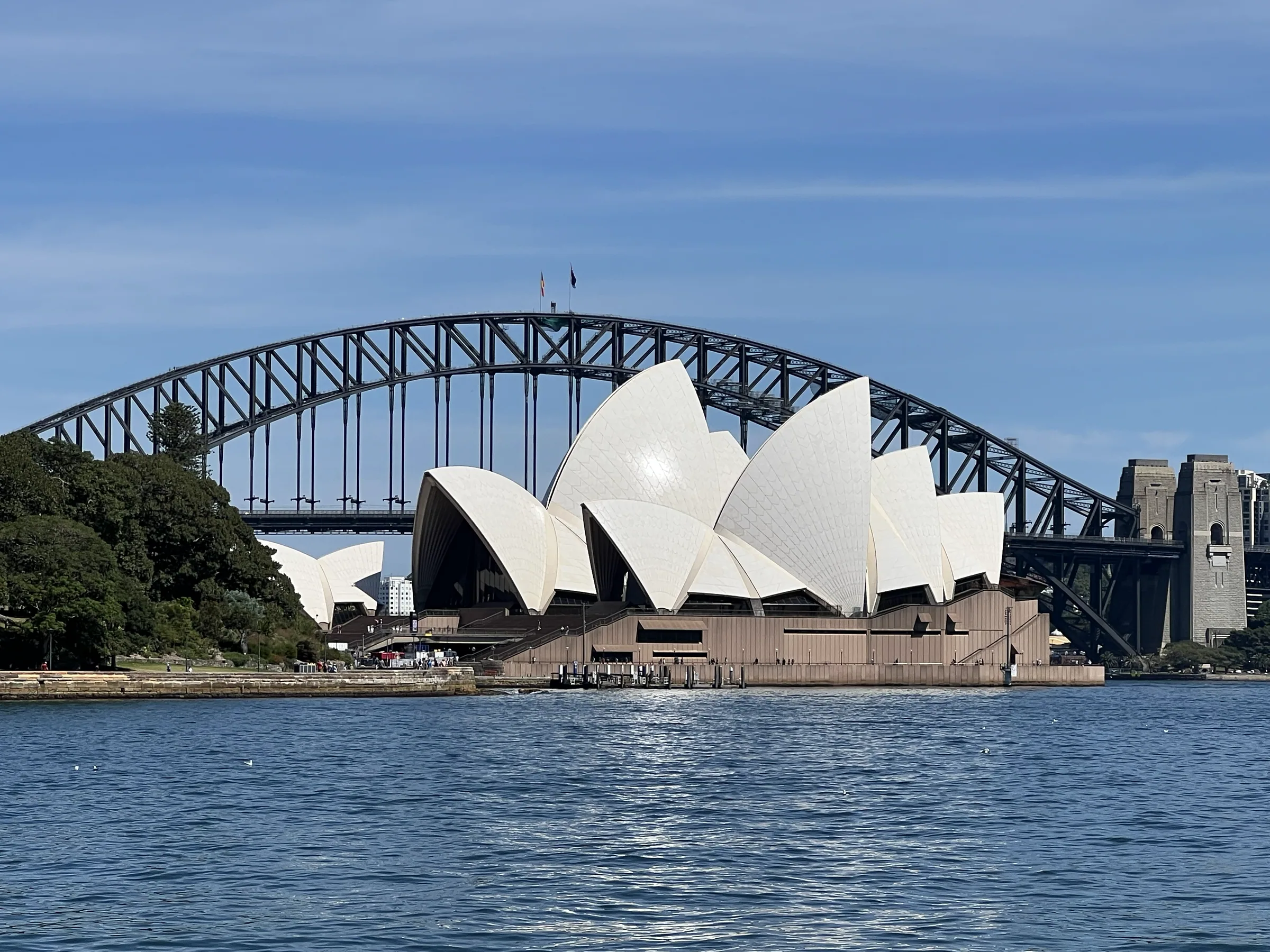
Sydney, Australia
Crossing the International Date Line, we began our Oceania journey at Taronga Zoo and the Sydney Opera House.
Cairns, Australia
A helicopter flight over the reef and rainforest, followed by snorkeling and an introductory dive at the Great Barrier Reef.
Melbourne, Australia
From the fly-infested Great Ocean Road to Puffing Billy, koalas, and the Phillip Island Penguin Parade.
Christchurch, New Zealand
From Christchurch, we crossed the South Island through pastoral country, a glacial lake, and fields of lupins before reaching Queenstown.
Auckland, New Zealand
We used a long Auckland connection to visit Hobbiton and the Waitomo Glowworm Caves, bringing our journey through Oceania to a close.
Crossing the International Date Line, we began our Oceania journey at Taronga Zoo and the Sydney Opera House.
Our journey through Oceania began with the difficult business of designing the itinerary. We had several constraints to satisfy.
First came New Zealand’s South Island. We did not feel like driving ourselves, so we joined a tour that ran between Queenstown and Christchurch once every five days. That immediately dictated the broad outline of the trip: either we went to New Zealand first and took the earlier departure, or visited Australia first and joined the tour five days later. We did not have separate New Zealand visas; under the policy that applied to us, our Australian visas allowed us to enter New Zealand provided we traveled there from Australia. That settled the matter.
The tour departed from Christchurch, which raised the next question: should we visit New Zealand’s North Island or South Island first? We found that flights from the South Island back to the United States generally required a connection on the North Island, while the North Island offered direct flights. South Island first, then, was the obvious choice.
We could now consider where in Australia we might fly to Christchurch from. Cairns was non-negotiable—we were going diving at the Great Barrier Reef. Cairns had no direct flight to Christchurch, however, so we would have to connect in either Melbourne or Sydney. In that case, why not stop and explore? Melbourne was noticeably cheaper, so we provisionally added it to the itinerary.
But how were we to get from the United States to Cairns? There was no direct flight there either; once again we had to connect in Sydney or Melbourne. A closer look revealed connection times so dreadful that they were unacceptable. So, once again: why not spend a day at the connection point? I compared the total airfare for Sydney, then Cairns, then Melbourne against the same route in reverse. The former was clearly cheaper and had much more sensible timing, so that became the plan.
You may find this hard to believe, but Melbourne was never part of our original plan at all.
And that, in summary, was how the itinerary came into being.
We left the United States on the evening of December 10, 2025. By the time we arrived it was already the 12th; December 11 had simply disappeared from my life.
For the fifteen-and-a-half-hour flight, we traveled in Premium Economy. My personal view is that most people who pay outright for Premium Economy are getting a poor bargain; it mainly makes sense as an upgrade. The difference from Economy is modest, the recline remains limited, and the fare is often more than twice as high. Yet when I checked the airline’s website, Premium Economy cost 70,000 points while Economy cost 87,000. It made no sense, but there it was.
So we booked Premium Economy. Only seats in the last row remained when we selected ours, and that was where the trouble began. The seats were close to the wall, further restricting how far they could recline. Anyone who has flown knows that aircraft seats are not exactly precision instruments. Their official recline is one thing; a sufficiently heavy passenger leaning back can sometimes persuade the mechanism to yield what feels like another ten degrees. Normally body weight can coax out a little extra angle. Against a wall in the last row, there was no such possibility. It was deeply uncomfortable. Lesson learned: I am never choosing the last row again.
In the end, we rested reasonably well—though on a flight that long, it was difficult not to. That afternoon, as planned, we visited Sydney’s well-known Taronga Zoo. Here was the zoo map.
At the zoo, it was another ordinary day of Fantastic Beasts and Where to Find Them.
There were also capybaras, now seemingly unavoidable internet favorites.
And koalas. We would see many more later at a zoo devoted specifically to them.
That brought the day to an end. We hurried back to the hotel to sleep and adjust to the time difference.
The next day, we visited the Sydney Opera House.
We joined an interior tour and wandered through much of the backstage area. The guide shared all manner of behind-the-scenes stories: the architect’s family drama, the passions and grievances surrounding the building, and a quiz for the group—was the only person ever to have climbed the Opera House Tom Cruise or Jackie Chan?
The next photograph shows one privilege of taking the interior tour: a concert hall, empty-auditorium edition.
Afterward, we had little else planned and a flight to catch that afternoon, so we walked through the nearby park. The scenery was quite lovely, and the park offered another distant view of the Sydney Opera House.
A helicopter flight over the reef and rainforest, followed by snorkeling and an introductory dive at the Great Barrier Reef.
It was already evening when we reached Cairns. After checking into the hotel, we went straight back out to find dinner. This was unmistakably the tropics: the restaurants and casual open-air eateries lining the street reminded me strongly of Hainan. There was no danger of going hungry. Food was everywhere, places stayed open late, and the night market was lively.
The weather looked good when we woke the next morning.
That day we took a sightseeing flight over Cairns and its surroundings, first circling above the inner Great Barrier Reef and then flying over the rainforest and mountains inland.
That was our only scheduled activity, so the rest of the day became a leisurely walk around town and along the waterfront.
The third day brought the main event of the entire trip: diving at the Great Barrier Reef. The excursion included both snorkeling and scuba diving. To take photographs underwater, we had bought transparent, fully sealed phone pouches while walking around town the previous day. They were expensive. A quick check on Amazon suggested that ordering online would have saved roughly twenty percent. We no longer had that option, of course, and a twenty-percent premium for buying one on the spot was not outrageous. Still, anyone planning a similar trip should bring a pouch from home.
We set out early that morning in high spirits. The excursion included hotel pickup, and because we were worried about missing the vehicle, we went downstairs well ahead of time. Eventually a small van arrived and drove us to the nearby marina. Cairns truly is compact: we could have walked to the marina in less time than we spent waiting for the ride.
Once aboard, we signed several liability waivers and assumption-of-risk forms without even reading them—our cheerful little stack of “sign here in case everything goes wrong” paperwork. Then came a ninety-minute boat ride to the first site.
Into the water!
We had assumed that as long as the pouch kept the phone dry, we would be able to operate it underwater. That proved optimistic. The pouch did keep the water out, but we could not operate the phone at all. It was not a defect in the pouch; everything worked normally at the surface. Underwater, however, our touchscreens simply stopped responding. Only the phone’s physical buttons still worked. Fortunately, we had anticipated this possibility and looked up a workaround in advance: in camera mode, the volume button acts as the shutter. Every underwater photograph we took was made that way.
There was one crucial rule: do not press the power button. If that happened, the adventure was over. The phone would lock, and without a working touchscreen there was no way to unlock it. Even with no passcode, we could not swipe past the lock screen and return to the camera. The only solution was to surface, unlock the phone, and dive down again.
So we swam along, hammering the volume button. The Great Barrier Reef really was beautiful—almost dreamlike.
Snorkeling here revealed more than coral. There were plenty of animals as well, especially tropical fish.
After climbing out of the water, we realized that we appeared to have forgotten our towels. The pre-departure information had advised bringing them because none would be provided, but I had forgotten. We had booked the excursion months earlier and I had never looked at those instructions again. A careless mistake. Our only choice was the ancient art of drying oneself: sun and wind. In that Pacific weather, the technique worked remarkably fast. A little sunshine and sea breeze dried our skin almost at once; after lying on a sunny deck chair for a while, even our swimsuits were dry. I would still strongly recommend bringing a towel. This method is not kind to the skin.
Because we were not certified divers, our scuba dive was an introductory one led by an instructor. On this particular excursion, that meant going a little over ten meters down. There was little point going farther anyway; we had already reached the seabed. We had read online that a phone might be fine at around ten meters, but the instructor told us it could break under the pressure and advised us not to take it. After weighing the risk, we left it behind.
For both scuba diving and snorkeling, we were advised to wear the full-body protective suits supplied on the boat, reportedly to guard against stinging jellyfish. We had not understood that. We assumed the suits were only for scuba, so we wore none while snorkeling. Seeing so many people on the boat changing into them, we wondered whether that many passengers were really planning to dive. They were, of course, snorkelers. When it was finally time for my scuba dive, I had still not put one on, and the instructor fitted the tank onto me before I had a chance. Fortunately, no jellyfish stung me. I did, however, accidentally scrape my knee against the reef on the seabed because my swimming skills were so poor, breaking the skin. Back aboard, we applied every disinfectant in sight for fear of infection. The lesson was clear: wear the suit.
We returned to the marina that afternoon and were told a shuttle would take us back to the hotel—in thirty minutes. No, thank you. We left and walked instead. Having learned from the morning, I knew I could have walked to the hotel twice in the time it took to wait.
On the fourth day, we joined a day tour of several attractions around Cairns.
The Curtain Fig Tree.
Millaa Millaa Falls.
And Paronella Park, often claimed to have inspired Hayao Miyazaki’s Castle in the Sky.
That brought our time in Cairns to an end.
From the fly-infested Great Ocean Road to Puffing Billy, koalas, and the Phillip Island Penguin Parade.
On our first day in Melbourne, we headed for the Great Ocean Road. This is where I must introduce the animal that left the deepest and most enduring impression on me there: the fly. The flies along the Great Ocean Road were everywhere. There was no escaping them. Wave a hand while walking and you were practically guaranteed to hit several. In theory, a creature as small as a fly should be difficult to spot outdoors from three meters away. Not here. They announced themselves freely. Many visitors simply wore masks, because opening one’s mouth to speak was an exceptionally dangerous act. One careless moment and you might receive an unexpected serving of fresh protein.
I do not know how much of the Great Ocean Road had this problem, but every attraction we visited did. My guess was that the damp coastal environment encouraged the flies, while the apparent lack of anyone controlling them allowed matters to reach this point. I had encountered something similar at Alcatraz near San Francisco, though this felt even worse to me. I would strongly recommend bringing a mask. Insect repellent did not seem particularly useful; there were simply too many flies for it to stop them all, and one could always find a few with no regard for their own survival. Walk carefully as well. Without glasses, a fly might go directly into your eye. One flew straight into my glasses.
Setting aside this spectacularly poor visitor experience, the Great Ocean Road did offer some fine scenery.
Our first stop was the Twelve Apostles. A photograph of this place appeared on the cover of an English textbook published by People’s Education Press in China, so visitors could often be seen holding the book in one hand and a camera in the other, lining up its cover with the landscape behind it. The result: it really was identical. What intrigued me most was where they had found those textbooks. Surely they had not carried them all the way from China? Then again, if they had come after reading a Xiaohongshu guide, perhaps they really had.
The coastal road was genuinely beautiful. Yet when I look at it now, my first thought is still: this is exactly the sort of environment in which flies would thrive.
We stopped at a restaurant more or less at random. Outside it, we happened upon several lively birds. They showed no fear of people whatsoever; presumably they had long since grown accustomed to us.
We then reached Split Point Lighthouse. We were told that excessive visitor numbers during the peak season had led to the site being closed, so all we could do was photograph it from a distance.
Finally, as the journey was nearly over, we arrived at the journey’s beginning. Had we spent the whole day doing the Great Ocean Road backward?
That concluded the first day. Back at the hotel, I went straight for the shower. After a full day among the flies, those clothes were not going anywhere near me again.
On the second day, we began with the Puffing Billy Railway, one of Melbourne’s best-known attractions. How should I put this? Judged purely as transportation, it was ancient, rough, and slow enough that few people would choose to rely on it. Judged as a classic heritage railway, however, perhaps age only makes it more desirable.
The ride itself was excellent. As the photograph above shows, when we rode it, passengers could sit along the edge of the carriage and extend their legs through the railings. There was obviously room for only so many people to do this in each carriage; roughly half had to sit inside. Whether you secured one of those places depended on when you boarded, or whether someone later offered to trade seats. The people in our carriage were considerate. No one occupied the prized edge for the entire journey of more than an hour without giving anyone else a turn.
Next came Maru Koala and Animal Park. As the name suggests, its defining feature was the chance to observe koalas at close range. Seeing them draped lazily over the branches settled the matter: they really are professional tree-dwelling idlers.
The park contained plenty of other animals as well. We encountered a peacock displaying its tail. It is the kind of thing that, no matter how many times you have seen it before, still makes you want to take a photograph.
The park also had a large contingent of Australia’s homegrown boxers: kangaroos, in several different varieties.
Capturing a large one and a small one in the same frame was no easy matter either.
That evening, we went to the Phillip Island Penguin Parade. “Penguins everywhere” came racing ashore from the sea. The quotation marks matter: there were plenty of penguins, but not quite enough to cover the landscape. I had already visited Antarctica and seen what penguins truly everywhere looked like. Compared with that, this was on an entirely different scale. The other people in our group were thrilled, probably because it was their first time seeing wild penguins. My own reaction was inevitably more subdued. I had, after all, already weathered rather larger seas—and larger crowds of penguins.
The photographs below were taken nearby during the day. When the penguins actually returned at night, it was too dark for my photographs to turn out well. Flash photography was understandably not allowed, so I captured nothing worth showing here.
And with that, our time in Melbourne came to a successful close.
From Christchurch, we crossed the South Island through pastoral country, a glacial lake, and fields of lupins before reaching Queenstown.
Our journey across New Zealand’s South Island began in Christchurch. The tour was agreeably unpredictable. We did not feel like driving ourselves, so we booked a multi-day group trip and simply looked at whatever our guide chose to show us. With no driving to worry about, every hour could be spent watching the landscape pass by. The guide knew the region’s attractions remarkably well and often carried us into obscure corners in search of popular photo spots.
We began in the city with Christchurch Cathedral.
Next came the botanic gardens, whose formal gardens had a character of their own.
Then we left Christchurch and headed deep into the countryside. As the vehicle continued south, the pastoral scenery of the South Island began steadily raising its game. It is difficult to describe in words. My recommendation is to look at the photographs and supply the poetry yourself.
That evening, I took a photograph in the small town where we stayed—proof, if nothing else, that I had been there.
We joined a stargazing tour that night, leaving at eleven and not returning until one in the morning. The southern sky differs from the northern one. My knowledge of constellations was nowhere near sufficient to explain how, but the stars in the Southern Hemisphere did seem brighter.
According to the guide, the southern sky appears to contain more stars largely because the center of the Milky Way lies toward the southern celestial sky, where the stars are densest and the Milky Way brightest. For an ordinary observer, he said, this makes the Southern Hemisphere better for stargazing. We were fortunate to have a perfectly clear night. The previous evening had been covered in cloud, and every stargazing group had received a refund.
This was the sky that night, photographed with the guide’s DSLR. My phone was plainly not capable of it. The picture would be different every day—or, more accurately, every moment. The stars themselves did not change appreciably, but meteors crossed the sky frequently, appearing at random almost as though they were continually respawning. Take the photograph at another instant and it would never be quite the same.
The next day brought another full day among forests, mountains, and pastoral landscapes. We stopped at a base offering scenic flights over the glaciers, though we did not book one. In Alaska, we had already toured a glacier by helicopter, and that aircraft had even landed directly on the ice. We decided we could pass this time.
We had instead booked a later excursion on Tasman Lake, taking a boat across the glacial lake to see the glacier. More than fifty years ago, what is now Tasman Lake was still almost entirely glacier. Today the glacier’s terminus continues to retreat rapidly, reportedly by more than a hundred meters per year on average. It remains New Zealand’s longest glacier, but at the present rate, I suspect our generation may see it retreat from an immense valley glacier into little more than residual ice high in the mountains.
The photograph below shows the starting point for the lake excursion. Fifty years ago, this was still glacier; now there was no trace of it. When it comes to glacial loss, I am thoroughly pessimistic. One might stop Europeans from using air conditioning, or Californians from buying gasoline cars, but how does one stop technology companies from constructing AI data centers? And how does one stop human civilization from moving forward? Those things seem to have an appetite for energy unlike almost anything that came before.
I do not mean that human progress should be obstructed in an effort to prevent global warming. My view has always been that problems created by technological development can only be solved by continuing to develop technology; trying to turn history backward is not a viable answer. For landscapes like this one, however, all I can say is: see them while they remain.
Over the following two days, the guide took us to many more places.
First came fields of lupins, spreading seemingly everywhere.
Only when we approached them did I realize that lupins belong to the legume family. After the flowers fade, they really do produce strings of furry seed pods.
The guide then took us to a number of “famous” social-media photo spots. The quotation marks are there because I had never heard of them, though they appeared to be popular on Xiaohongshu. One was this mountain bungee site. Its setting could hardly have been better: mountains, water, and a cliff to jump from. Promotional material claimed it was the world’s first commercial bungee-jumping site. I do not know whether that was true, but that was the line. I hesitated. I had bungee-jumped before, so doing it here would not have been a first, and in the end I declined. Later, I regretted it a little. I should have gone. It was an auspicious setting: succeed and it was a fine place to jump; fail and it would become an exceptionally permanent resting place.
We also saw the Lone Tree. That is the name of the popular photo spot. As the photograph shows, one tree stands by itself in the water. Becoming an internet-famous tree is apparently easy: all it has to do is leave the group chat.
We saw the unusual sight of a two-colored lake, along with still more beautiful pastoral scenery.
After four days on the road, we finally arrived in Queenstown. Our journey across New Zealand’s South Island had reached a fitting conclusion.
We used a long Auckland connection to visit Hobbiton and the Waitomo Glowworm Caves, bringing our journey through Oceania to a close.
For the final stop of our journey through Oceania, we reached New Zealand’s North Island. To be honest, our original plan was simply to enjoy the country’s pastoral scenery, and the South Island seemed sufficient. Yet every flight from the South Island back to the United States required a connection on the North Island, and the connection times were uniformly dreadful. Since we were going to be there anyway, we might as well…
We searched online for things to do on the North Island and discovered Hobbiton. It had served as a filming location for several movies in The Lord of the Rings series and looked well worth visiting.
I had seen every film in The Lord of the Rings series, including the later Hobbit films. I was not a devoted fan, however, and could no longer remember many of the classic scenes. That did not matter. No knowledge of the films was necessary; the village itself had enough character to justify the visit.
The first thing we encountered at the entrance was a life-size Gandalf. Many of the people waiting to enter stopped for a photograph with him.
The site organized guided tours in several languages. English tours were plainly the most frequent and could generally be booked at almost any time, while tours in other languages were harder to secure. Chinese tours were especially difficult: demand was high and departures were limited. We did manage to book one. Had we ended up on an English tour, the guide might have started making jokes about the films while we stood there understanding the words but none of the references.
The first sight upon entering the village was its sign.
Then we entered the village itself. Visitors could often be seen striking all manner of strange poses for photographs—for example, launching into an enormous leap on an otherwise unremarkable path. No great powers of deduction were needed to realize that they were recreating scenes from the films.
It was a thoroughly developed attraction, except that my phone had no signal at all and could only use the local Wi-Fi. My location-tagged WeChat Moments post very nearly failed to make it out of Hobbiton.
Afterward, we visited the Waitomo Glowworm Caves. A guide took us into the cave aboard a small boat, and overhead the rocky ceiling was covered with points of light from the glowworms. It was an unusual and memorable experience. The photographs, however, were another matter. The lights were so small that the results looked little different from pointing a camera at the night sky, and were simply not worth showing here. As an aside, these “glowworms” are not fireflies in the usual sense, but the luminous larvae of an insect.
That completed the day we had arranged around our Auckland connection. With it, our journey through Oceania came to an end.