Chengdu, Served Extra Spicy
Chengdu, China
Chengdu hot pot brought me to my knees before sesame oil came to the rescue.
A journey from Sichuan to Xi’an, through mountain landscapes and cities along the way.
May 2–8, 2017 · Chengdu · Huanglong Scenic Area · Jiuzhaigou Valley Scenic Area · +1 · 4 entries
Chengdu, China
Chengdu hot pot brought me to my knees before sesame oil came to the rescue.
Huanglong Scenic Area, China
The beautiful display photos delivered one last blow.
Jiuzhaigou Valley Scenic Area, China
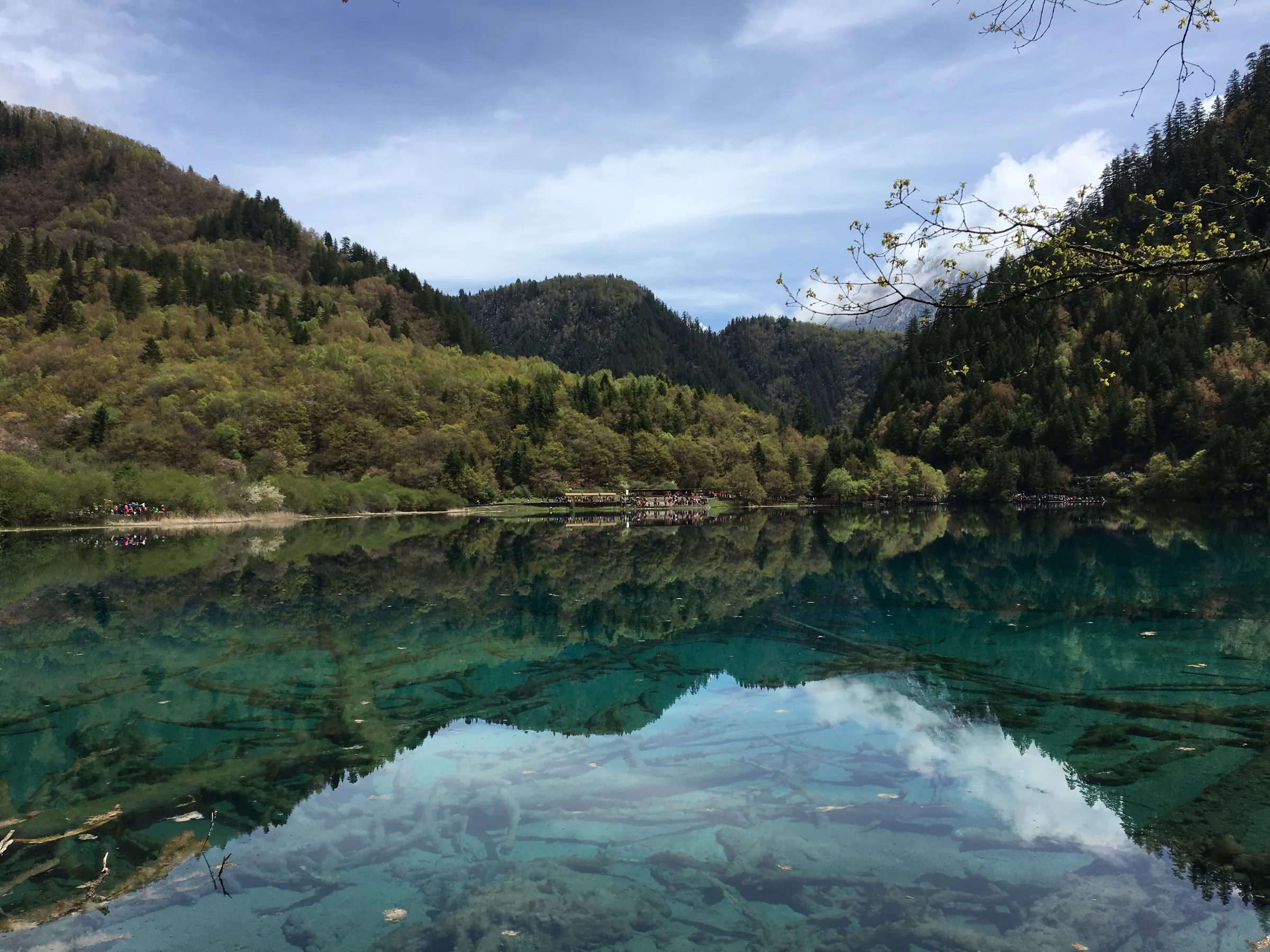
Clear lakes, forested mountains, waterfalls, and a last trace of spring snow.
Xi'an, China
The Terracotta Army, The Song of Everlasting Sorrow, and bronze swords from the Qin dynasty.
Chengdu hot pot brought me to my knees before sesame oil came to the rescue.
The most important thing to do in Chengdu was eat hot pot, and this particular hot pot quickly taught me a lesson. Its spicy broth seemed to exist in an entirely different dimension from anything I had tried before. The proper method was to swish food from the pot through the bowl of sesame oil shown below. Much of the chili oil would slide off, leaving the food considerably less spicy.
I knew none of this. The sesame oil simply struck me as strange. Wouldn’t dipping meat in oil make it unbearably greasy? So I ate it straight from the pot. I remember the fourth slice of meat very clearly: that was when I hit my limit. I could not swallow it and had to spit it out. It was far too spicy.
Then I tried the sesame oil. Consider me converted.
I do not know exactly what was in it, but the meat did not taste greasy at all after the dip, and the heat dropped to a level I could actually handle. It felt like magic.
Next we went to Kuanzhai Alley. And once there, one naturally has to mention a famous old verse that has absolutely nothing to do with it: a letter sent a thousand miles over a wall, the wisdom of yielding three feet, the Great Wall still standing while Qin Shi Huang is long gone.
Never mind the actual allusion. The guide was certainly going to find a connection somehow.
The lanes were lined with snacks. At a restaurant I also tried ice plant for the first time. The beadlike structures that look like water droplets are actually specialized bladder cells on the plant’s surface. They store water and salt, clinging to the stems and leaves like tiny translucent pouches.
That was new to me. It probably was not a Sichuan specialty, but I had certainly never seen it before.
Beyond food, a few things seemed to be everywhere in Chengdu. First came street mahjong—so many people were playing mahjong. The city felt leisurely and unhurried to me, and we often passed large groups playing out on the street. It is difficult to describe the scale of it; if you have never seen the scene for yourself, it is hard to imagine.
Then there were pandas. Shops selling panda merchandise, especially stuffed animals, seemed endless.
On the second day, we went to Dujiangyan.
Dujiangyan was first built during the Warring States period under the direction of Li Bing. Its great achievement was not simply damming the Min River. Instead, an integrated system—including the Fish Mouth, Flying Sand Weir, and Bottle-Neck Channel—diverted the river, carried away sediment, and guided water into the Chengdu Plain. More than two thousand years later, the system still functions, and it played an important role in turning the plain into the fertile region known as the “Land of Abundance.”
Our guide delivered a wonderfully animated explanation of water diversion, sediment removal, and flood control. I followed the words, but the engineering itself remained well beyond me. After staring at it for quite a while, my main conclusion was simple: the ancient engineers were brilliant; I understood almost none of it.
After that, we wandered around and took the obligatory photographs.
On the third day, we visited Du Fu Thatched Cottage, the site of the poet’s former home in Chengdu. Du Fu arrived here after being displaced by the An Lushan Rebellion and lived in Chengdu for several years. During that period, he wrote many of the poems that would later appear in Chinese school textbooks.
Then we found proof that even an oil lamp can be remarkably economical…
The grounds themselves were wonderfully peaceful, with bamboo, winding paths, old trees, and traditional buildings scattered throughout. Most of what stands today was reconstructed or expanded in later periods, but as a place honoring Du Fu, the atmosphere felt exactly right. A winding path into a secluded garden, with trees and flowers gathered around a quiet retreat—that old line of poetry suited the place rather well.
We then visited Wuhou Shrine. The shrine primarily commemorates Zhuge Liang, while also honoring Liu Bei and other figures from the state of Shu Han.
Lines I had known from school textbooks were suddenly there in front of me. One famous couplet praises Zhuge Liang for devising the strategy of the realm after three earnest visits and for serving two reigns with a veteran minister’s devotion. I had only memorized it from a textbook before; now I was reading it at the shrine of the person it described.
That brought our independent wandering around Chengdu to an end. Next, we were preparing to fly to Jiuzhaigou Valley Scenic Area.
The beautiful display photos delivered one last blow.
After our flight landed, we spent two hours being tossed from side to side on a bus before finally reaching Huanglong Scenic Area.
Our timing was unfortunate. The water level at Huanglong was still very low. People generally come here for the mountains and water, but the colorful pools before us held precious little of the latter. Huanglong is best known for its tiered travertine pools. When there is plenty of water, it flows through one terrace and shallow pool after another, creating a beautiful scene. During our visit, however, many of the pools along the way were almost completely dry. What appears below was about as much water as we saw that day.
And then came what felt like the comparison shots. It almost seemed as though the park knew that visitors might be disappointed when there was so little water, so it had put up photographs showing what the scenery should look like when the pools were full.
The difference was, shall we say, not exactly subtle. Since the water in those photographs was nowhere to be found in reality, we had to supply it with our imagination.
And then we left disappointed. No twist. No sequel.
Clear lakes, forested mountains, waterfalls, and a last trace of spring snow.
Jiuzhaigou lies in Jiuzhaigou County, part of the Aba Tibetan and Qiang Autonomous Prefecture in northern Sichuan. It is a World Natural Heritage site defined by alpine lakes and waterfalls.
That is enough background.
Scenery this beautiful needs no introduction; it can speak for itself. It also more than made up for what we’d missed at Huanglong the day before.
Sunlight moved across water so clear that forest, mountain, and reflection seemed to share the same depth.
Where the wind left the lakes alone, the mountains appeared twice—once above the shore and once beneath it.
Water slipped through the forest, then gathered itself into broad curtains over the rock.
Between one view and the next, the boardwalk kept threading through the mountains.
Fresh snow had turned the upper slopes white, while spring was already returning below.
All right, that is enough of my brief career as a landscape poet. The photographs can take it from here.
The Terracotta Army, The Song of Everlasting Sorrow, and bronze swords from the Qin dynasty.
After landing in Xi’an, our first stop was the Emperor Qinshihuang’s Mausoleum Site Museum to see the Terracotta Army. The scale is immense: thousands of terracotta soldiers and horses form a vast underground army, with noticeable differences in clothing, hairstyles, and expressions from one figure to another. Preparing an army this large for himself more than two thousand years ago—Qin Shi Huang certainly knew how to plan ahead.
I seem to remember coming here back when I was doing academic competitions in high school. But that memory is now so distant that not even a vague impression remains.
But wait—is this high-ranking officer actually Louis Koo? After all, he did travel back to the Qin era as Xiang Shaolong in A Step into the Past.
The view from Mount Li was excellent.
I also fed a peacock nearby, and the photograph turned out remarkably well.
That evening, we watched The Song of Everlasting Sorrow, a large-scale outdoor historical dance drama at Huaqing Palace. The production follows the story of Emperor Xuanzong of Tang and Yang Guifei, using Huaqing Palace and Mount Li as its real-world backdrop alongside lighting, dance, and elaborate stage effects.
The production certainly earned its “large-scale” billing.
The next day, we visited the Shaanxi History Museum. Its collection spans the long history of artifacts unearthed across Shaanxi, including objects from the Qin dynasty. The bronze sword in the photo was excavated from Pit No. 1 of the Terracotta Warriors, and nearby was the famous Du Tiger Tally.
More than two thousand years old, the swords could still be seen intact before us. Their long, slender blades retained a remarkably sleek profile.
Nothing else left much of an impression.
And with that, the journey was over. It was time to return to the United States and take the team to the finals.