My First Academic Conference
Chicago, United States
Presenting a paper in Chicago, with a front-row view of the Trump frenzy in 2016.
Research, academic conferences, and the stories that shaped my years as a PhD student.
May 26, 2016 – December 5, 2018 · Chicago · Orlando · Ann Arbor · 3 entries
Chicago, United States
Presenting a paper in Chicago, with a front-row view of the Trump frenzy in 2016.
Orlando, United States
Paper presented, with time afterward to try the newly opened Volcano Bay.
Ann Arbor, United States
I passed my dissertation defense, and it was time to say goodbye to Ann Arbor.
Presenting a paper in Chicago, with a front-row view of the Trump frenzy in 2016.
My first paper was published at the International Parallel and Distributed Processing Symposium (IPDPS). It is one of the leading international conferences in parallel computing and distributed processing, with related work in high-performance computing and computer architecture as well.
In my own informal hierarchy, IPDPS was never going to outrank STOC or FOCS in theoretical computer science, or SC in the hardcore HPC world. But within parallel computing and distributed systems, it was absolutely among the very top conferences.
Getting a paper into IPDPS in the second year of my PhD was a considerable stroke of luck.
My first stop in Chicago was the Trump International Hotel & Tower. Our conference was being held at another hotel nearby, and I briefly considered staying at the Trump for a night. That idea ended exactly as expected: it was too expensive, and I could not afford it.
The university was reimbursing my lodging and meals, subject to a limit whose actual amount I did not know. The limit existed in theory; in practice, someone would simply hint that a price was too high. For reasons I never understood, the regular room rate I found for the conference hotel was extraordinarily expensive that Monday—$600 for one night—while the other nights were a little over $300. I submitted that quote for reimbursement and, sure enough, was told that it was absurdly expensive and that I should find somewhere cheaper. So I stayed at another nearby hotel for the first three nights and at the conference hotel for the final three. In the end, everything was reimbursed successfully.
The conference welcome event included a live musical performance. Once people began chatting, the subject that inevitably came up was Trump.
This was during Trump’s first campaign for the U.S. presidency. The topic was not merely hot; it was, to use the precise technical term, extremely hot. Put a table of strangers together with no obvious subject to discuss, and somehow the conversation would make its way to Trump.
I also saw a meme online at the time. The other candidates were labeled things like “the first woman president” or “the first president born in Canada.” Trump was simply “the last president of the United States.” That one made me laugh far more than it should have.
My English political vocabulary was painfully limited. While everyone else chatted away, I mostly listened and laughed along.
Then it was finally my turn to present my paper at the conference.
And so I came away with one precious photograph of the occasion.
Paper presented, with time afterward to try the newly opened Volcano Bay.
I had another paper published that year, and once again I felt extremely fortunate.
I am not trying to humblebrag here. I really was fortunate. Publishing papers was quite difficult in our theoretical computer science group. The theory itself was hard enough, but just as importantly, our papers often had a single student author and one advisor; long author lists were uncommon. Meanwhile, the AI group next door and the hardware group one door farther over seemed to produce ten papers per person every year, each with ten authors. Were they grinding publication stats over there or what?
That is an exaggeration, but it captures the general idea. At least from where I stood at the time, they really did publish far more papers than we did.
I had also assumed that the little niche I had chosen might happen to be exactly the sort of thing this conference liked, which was why I had managed to publish there. For a while, I thought perhaps I could keep doing this in the years ahead. As it turned out, I was getting ahead of myself.
The university covered the trip again, and this time I stayed at the conference hotel throughout. It was in the Disney resort area, and the surroundings were excellent.
Soon after I arrived, something vaguely vulture-like flew onto my balcony, apparently intent on competing with me for food.
The conference schedule was relentless. After one talk after another, I spent much of the time trying to work out what I had just heard.
In theory, I could have eaten every meal at the hotel. In practice, the food did very little for me, so I had to venture out in search of something better. It was a resort area, though, and the surroundings truly were hard to fault.
That year, I once again took the stage to present my paper.
And once again, I came away with one precious photograph of the occasion.
After the conference, we made a special trip to Universal’s Volcano Bay, which had opened only a few days earlier. We had not known about it before arriving in Orlando; it simply popped up when we searched online. I would not say the advertising was inescapable, but we certainly saw plenty of it.
And then there were the ratings. If I remember correctly, it had only a 2.8 on Google Maps at the time, which was spectacularly bad. By the time I wrote this entry, the rating had climbed all the way to 4.5. In later visitor reviews, I could even find quite a few positive comments about its wristband-based virtual queue system—the very feature that had been savaged when the park first opened. The complaints said that it frequently lost its connection or otherwise failed, that a virtual wait for a single attraction could last for hours, and that while waiting for that attraction, guests could not join another virtual queue. Even when their time finally arrived, they might still face a physical line, only for the attraction to shut down temporarily, and so on.
Those bad reviews seemed to be aimed more at the operational problems of a brand-new park than at whether the park itself was actually fun. We ultimately decided to ignore them and give it a try. The result was a very pleasant surprise: none of those problems affected us. Everything went smoothly that day, the crowds were light, and we could enjoy almost every attraction with very little trouble. It was an excellent experience.
I passed my dissertation defense, and it was time to say goodbye to Ann Arbor.
Before I knew it, the day of my dissertation defense had arrived.
I had lived in this city for six and a half years. Looking through my phone, I discovered that I had hardly any photographs of it. Perhaps the longer you live somewhere, the more ordinary it begins to feel.
So here are a few photographs from earlier years.
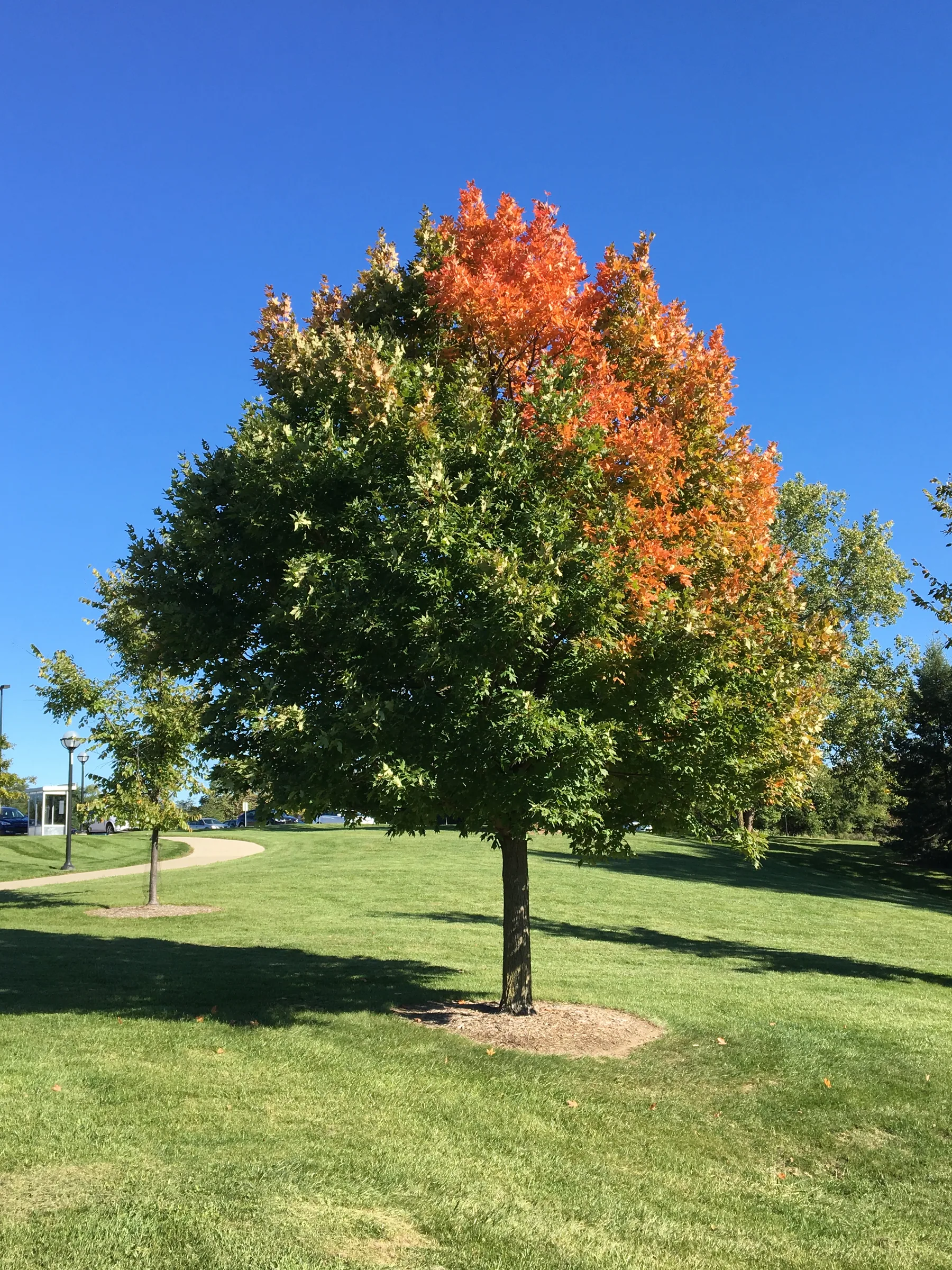
A tree on North Campus. Absolutely beautiful.
The wildlife I regularly encountered by the roadside.
And then there were the little squirrels that seemed to be everywhere around my apartment complex. Ann Arbor squirrels were ridiculously fat. After I moved to California, every squirrel there looked half-starved by comparison.
The two in these photographs were not even particularly impressive. Go to Central Campus and see someone carrying a mountain-sized bag of nuts to feed the squirrels, and then you will understand what a truly fat squirrel looks like.
The weather around town could change in an instant. It took only three hours to go from green grass to a blanket of snow—and I could photograph the entire transformation without leaving home.
And that was it. I could not find any more photographs.
Back to the defense. It went smoothly. I already had papers in top conferences, so I wasn’t particularly worried about graduating.
After the defense, my committee had a short meeting. About twenty minutes later, my advisor came out and told me there were still a few things in the dissertation that could be polished, but after discussing it, they decided there was nothing that really needed to be changed. So they left it at that.
And I passed.
Many thanks to my advisor for making it so easy on me at the finish line.
A week later came the retirement ceremony for a senior professor who had taught at the university for 34 years. He had also served on my dissertation committee. He was the head coach of our ICPC team, and I had known him since I first arrived at the university. In my first semester, I took one of his courses, absolutely crushed all three exams, finished at the top of the class, and earned an A+. I suppose we made quite an impression on each other after that. He and my advisor had been friends for decades.
The ceremony needed a student representative to give a speech, and they chose me.
My advisor was representing the faculty and spoke first. After finishing his own remarks, he needed a way to introduce me. He said, “This student will be speaking in a moment. He defended his dissertation a few days ago. Fortunately, he passed, or I have no idea what he would be saying today.”
The jokes never stopped coming. Thanks for that. They had only asked me to give the speech a few days earlier; if I had failed my defense, I probably would not have accepted the job.
Then I went up and spoke. It was a great success—perhaps more successful than my dissertation defense. I did not use a script, so the delivery felt natural. I turned stories from the previous six years into a ten-minute comedy routine, and it went over extremely well. Several professors came after me with compliments and told me I had a talent for comedy. All those years of watching the Chinese comedy roast show Roast! (《吐槽大会》) had finally paid off.
When I first arrived in the United States, about all I could manage at a burger place was “Number One.” As soon as the cashier asked a follow-up question, I was completely lost. And now, somehow, I could do a comedy routine in English. Perhaps academics were not the only thing that had improved over those years.
Until we meet again, Ann Arbor.