Tokyo in Spring: Cherry Blossoms, Missed Tours, and Mount Fuji
Tokyo, Japan
A spring visit to Tokyo that began with a missed tour and ended with cherry blossoms, city streets, and a clear view of Mount Fuji.
From cherry blossoms in Tokyo and views of Mount Fuji to Kyoto, Nara, Kobe, and Osaka, a journey through Japan in spring.
March 26–30, 2025 · Tokyo · Osaka · 2 entries
Tokyo, Japan
A spring visit to Tokyo that began with a missed tour and ended with cherry blossoms, city streets, and a clear view of Mount Fuji.
Osaka, Japan
Three packed days based in Osaka, roaming through Kyoto, Nara, and Kobe for temples, cherry blossoms, city landmarks, and plenty of food.
A spring visit to Tokyo that began with a missed tour and ended with cherry blossoms, city streets, and a clear view of Mount Fuji.
That March, we went to Japan to see the cherry blossoms.
As usual with my travel stories, the visa came first. A Japanese visa was easy to obtain—at least from where I lived in the United States. The document requirements were clear, submission was straightforward, and approval was quick. In short, nothing went wrong, and the visa arrived soon afterward.
We booked two day tours from Tokyo. The original plan was Mount Fuji on the first day, a miscellaneous selection of nearby sights on the second, and a day on our own on the third.
By the time our flight arrived, it was already six in the evening. We had heard that the airport express was the sensible way into the city and that a taxi would be both expensive and slow in traffic. We bought tickets and managed to squeeze onto a train departing five minutes later.
After dropping our luggage at the hotel, we went looking for food. At a 24-hour convenience store, we picked up a random assortment of pastries, bread, and snacks. Back at the hotel, we tried them—and they were excellent. Japanese convenience-store pastries lived up to their reputation. By my own highly subjective standards, this casual selection could have trounced almost every pastry shop I had tried in the United States.
Then we went straight to sleep. I was getting too old to shrug off jet lag, and more importantly, the tour began at eight the next morning. To be safe, we had booked a hotel only a fifteen-minute walk from the meeting point. Unfortunately, that did nothing about having to wake up at seven.
The next morning brought the biggest mishap of the trip.
We left with plenty of time and, predictably, got slightly lost along the way. When we reached the meeting point, ten minutes remained before departure. Ten minutes should have been ample—until we saw the scene.
We had imagined one guide holding a small flag and checking names on a sheet of paper. Instead, there were twenty guides from the same company, some holding identical flags and others holding none at all, while what felt like ten thousand people crowded the edge of one cramped intersection.
That is barely an exaggeration. Moving through the crowd required actual squeezing, and bumping into people was unavoidable.
We spent ten minutes searching and still could not find our guide. The central problem was that we had no idea who the guide was: no contact details, no photograph, nothing. We showed our booking page to one of the other guides. He had never seen it and knew nothing about it.
Eight o’clock arrived, and the crowd began departing in groups. Even when only one guide remained, ours was nowhere to be found.
For no particular reason, I suddenly thought to check my email. There was a message from the previous evening containing the day’s detailed instructions—including the guide’s WeChat ID. I added him immediately. He told us the bus had left on schedule after waiting an extra two minutes. With more than fifty people aboard, it could hardly wait indefinitely.
And that was how we missed the day’s Mount Fuji tour.
It was not a disaster. We rebooked the identical tour for our third day and turned this one into our free day instead. First, however, we went back to the hotel and slept.
By noon, we were ready to eat and wander. We honestly had no destination in mind. I searched online for notable places nearby, marked all of them on the map, and set out.
Our first stop was Ueno Park.
At the time, we did not realize that this was a famous cherry-blossom destination; we knew only that it was a park where people went to see flowers. I later learned that it may be one of Tokyo’s best-known places for cherry blossoms, and that it also contains cultural institutions such as the Tokyo National Museum and Ueno Zoo. No wonder it was so crowded. The blossoms themselves were less impressive: very few had opened. We wandered around the park anyway.
Next came the center of the two-dimensional universe: Akihabara. It is Tokyo’s best-known concentration of anime, manga, and gaming culture, with specialty shops, themed cafés, and enormous electronics stores everywhere. Originally famous as an electronics district, it gradually became one of the world’s emblematic centers of otaku culture. That history inevitably reminded me of Akihabara’s reigning power broker in Steins;Gate, Faris NyanNyan.
We explored shop after shop, including a fair number devoted to material unsuitable for children. Akihabara truly was anime heaven.
That evening, we went to Ginza and wandered through several strikingly designed stores. One shop was supposedly famous above all for its elevator. We circled the area for ages and never found it.
That was the end of our first day.
On the second day, we joined the other tour and visited a few sights outside central Tokyo. Having learned from the previous morning, we added the guide on WeChat well in advance and found him without difficulty. The company used more than one departure point, and this one was just as crowded. Without that advance contact, we almost certainly would have failed again.
To be honest, the itinerary was not especially memorable. The exception was Kawagoe Hikawa Shrine. It is said to be particularly auspicious for finding a partner, and many people come to pray for romantic fortune. The shrine is best known for its sea-bream-shaped fortunes, which visitors fish up like tiny catches. They filled rack after rack—quite literally rows of them.
Nearby was Hikawacho, the neighborhood containing the shrine rather than a separate attraction in its own right. Most visitors come for the shrine and then walk along the Shingashi River, which is especially scenic during cherry-blossom season.
The photograph makes it easy to see why this is another popular place for cherry blossoms. Unfortunately, they still had not really opened.
That concluded the second day.
The third day brought the centerpiece of the trip: seeing Mount Fuji from a distance. Armed with the lessons of day one and the experience of day two, we reached the waiting area very early, met the guide before the crowds arrived, and settled into the bus.
Our guide was remarkably capable. He was Chinese, so Mandarin was naturally his first language. He worked as a guide in Japan, and his Japanese sounded fluent when he spoke with the driver. He had also spent years working in South Korea and spoke Korean fluently. Half the passengers that day were Chinese, half were Korean, and the driver was Japanese; we listened as he moved effortlessly among all three languages. Later, we encountered some lost Europeans, and he managed a little English as well. His English was not strong enough for a full conversation, however, so we stepped in to interpret. He said he planned to study seriously so that he could eventually lead European and American groups—Americans in particular, he added, came from a tipping culture and might mean more extra income.
We left on time. As the bus moved, the guide began lowering our expectations. Mount Fuji, he warned, was notoriously difficult to see. According to him, statistics suggested that on average it was reasonably visible in full on only about 140 days each year. He had checked the day’s forecast and was not optimistic, so we should not expect too much. He had even prepared small gifts to console the passengers if necessary.
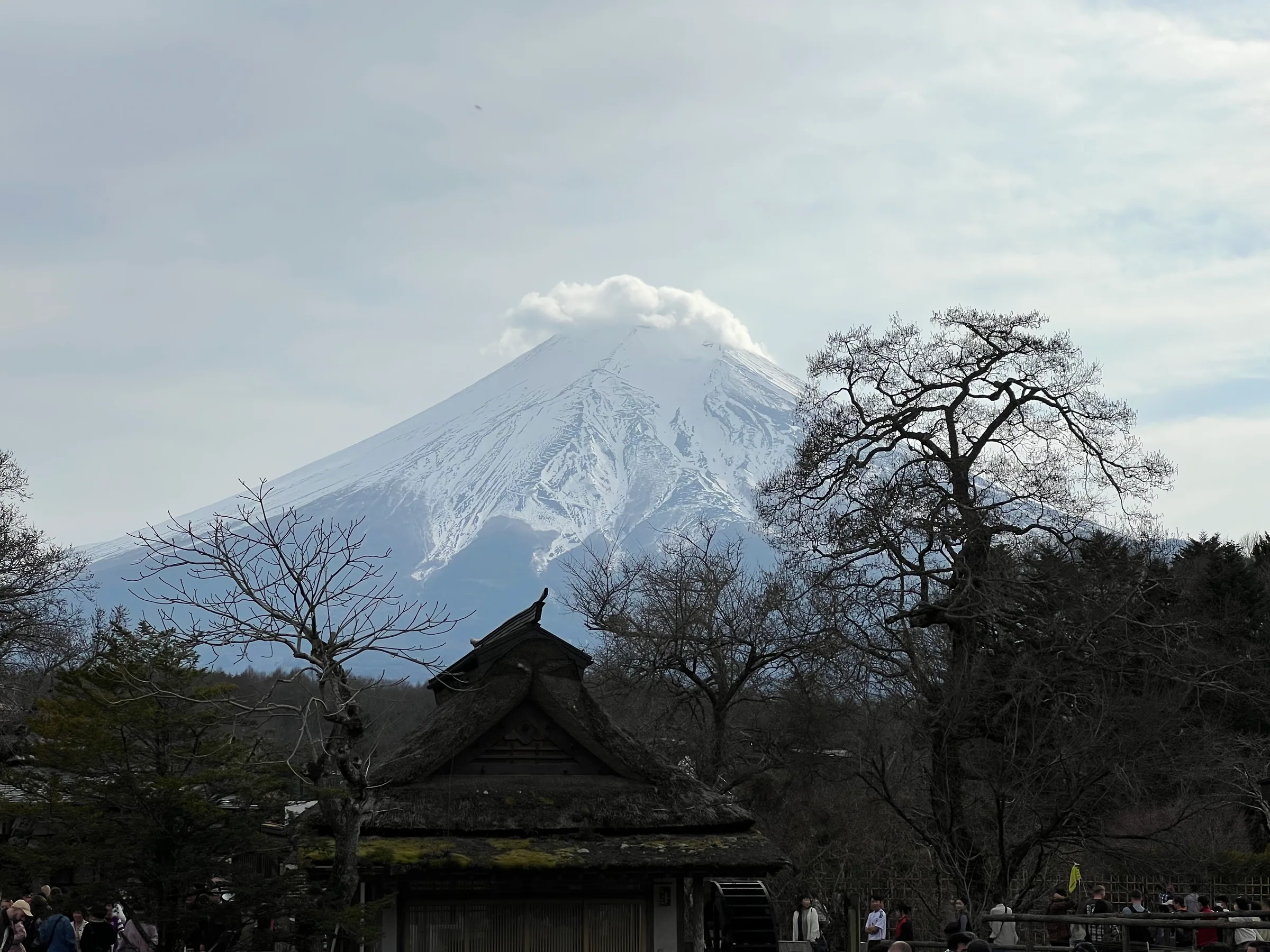
Then we saw Mount Fuji from the bus.
He seemed almost surprised. We were extraordinarily lucky, he said. The previous two groups had not enjoyed anything close to this view; two days earlier, clouds had covered the sky all day and they had seen absolutely nothing.
Everyone was delighted and began taking photographs through the windows. The guide, I had to admit, was exceptionally good at expectation management.
Our first destination was Hakone, where we would see the torii standing in the water and ride a sightseeing pirate ship. Along the way, the guide explained that he had to compete for tickets every morning and simply take whatever sailing he could secure. On an unlucky day, he might get none at all, forcing the group to travel to the next stop by road. Most tour buses arrived within roughly the same window, he said, so success was largely a matter of luck. The expectation management had begun again.
There was, however, a little shortcut. Under the normal plan, the bus drove directly uphill to the parking area. The passengers stayed near the shrine while the guide sprinted downhill alone to buy the tickets. Whenever the buses arrived, the guides effectively staged an eight-hundred-meter final among themselves.
Procedures in Japan are generally followed fairly strictly, so that was usually how things worked. But if a guide had a good relationship with the driver, the driver might briefly stop at the small lot below the hill and let the guide out before continuing upward. That dramatically improved the odds of obtaining tickets. The lower lot was tiny and awkward for a bus, and the stop was outside the driver’s normal route, so the arrangement depended entirely on the guide’s rapport with the driver.
Our driver was willing to help. He stopped below, and the guide bought the tickets without having to sprint. Expectation management, relationship management—our guide appeared to excel at every form of management.
We first visited the shrine on the hill, then viewed the torii from land. The crowds were extraordinary. To take a photograph, I had to use my own body to block everyone else from the frame.
Then we boarded the pirate ship.
From the water, we saw the torii again from a different angle.
Next came Owakudani. The mountaintop was wrapped in fog and battered by fierce wind. We tried the famous black eggs afterward. Personally, I could detect no difference whatsoever between one of those and an ordinary boiled egg.
Then we had lunch. The guide ordered everything in advance, so the food was ready as soon as we arrived—a very efficient arrangement, although we paid for it ourselves. It was supposedly A3 wagyu. I certainly could not identify the grade, but the meat did melt in my mouth.
After lunch, we reached Oshino, an excellent place from which to view Mount Fuji.
We photographed the mountain from every angle.
There was also the cloud-wrapped version.
That concluded the tour. On the return journey that afternoon, the guide handed out the small gifts he had prepared after all. When he reached us, he quietly slipped us a little extra to make up for the tour we had missed on the first day. Still, he told us, missing that tour had been fortunate. The group two days earlier had seen nothing, while we had seen everything; Mount Fuji had truly cooperated with us. We had missed the tour, he said, but we had not missed what mattered.
That evening, we went to a restaurant said to serve eel in several different styles. We tried both Kansai-style and Kanto-style eel. We were told that the Kansai preparation was crisper and the Kanto version more tender. The Kansai dish we ate did indeed taste different from the soft eel I had encountered before.
With that, our time in Tokyo came to an end.
Three packed days based in Osaka, roaming through Kyoto, Nara, and Kobe for temples, cherry blossoms, city landmarks, and plenty of food.
Our days in Osaka were remarkably busy. We explored not only Osaka itself but also the nearby cities of Kyoto, Nara, and Kobe—every one of them.
On the first day, we began in Kyoto.
Our first stop was Kiyomizu-dera.
The temple stands on a hillside, offering views across the city of Kyoto.
We then walked through nearby Ninenzaka and Sannenzaka, where we saw Hokan-ji’s famous five-story pagoda.
Nearby, we also found this distinctly Japanese Starbucks, where customers could sit on tatami while drinking coffee.
Then we reached the place I had most wanted to visit in Kyoto: Fushimi Inari Taisha. People online sometimes claim that it inspired the Grand Narukami Shrine in Genshin Impact, in which case there ought to have been Electroculi everywhere.
The resemblance to the game was difficult to ignore. I would not say the two looked exactly identical—only that there was practically no difference.
From there we continued to Nara and met its most famous creatures: the deer. After generations of exposure to tourists, Nara’s deer had lost all fear of people. If anything, they were the frightening ones. Hold food in your hand and a deer would reach over and eat it. Put the food in your bag and it would put its head into the bag and take it. More than once, we saw deer chasing people down the path. They were formidable.
Fortunately, we had no food in our hands.
We reached Todai-ji and finally shook off the herd behind us.
After walking around the temple, we wandered through a nearby park. There we found what may have been the finest cherry tree of the entire trip. What drifted through the air was not snow, but cherry blossoms.
And with that, our visit to Nara ended at remarkable speed.
On the second day, we went to Kobe. We began at Kobe Port Tower and took the elevator to the observation deck. Visitors could borrow various signs for photographs. One read “神戸ビーフ最高”—“Kobe beef is the best.” With my A0-level Japanese at the time, I somehow interpreted it as “Kobe’s tallest building.” I had thoroughly confused ビーフ, “beef,” with ビール, “beer.” Worse still, ビール does not mean building at all; that would be ビル. I had managed to be wrong twice in a single reading.
From the top, we photographed the panorama of Kobe Harbor.
Back at ground level, we stopped for a photograph at one of Kobe Harbor’s familiar landmarks. The area was crowded, so I used my usual method: wait for one group to leave, take the picture in the gap, and move on immediately.
At noon, we ate whatever we could find nearby. That had not been the plan: we entered a restaurant in Kobe specializing in Kobe beef, only to discover that this Kobe beef restaurant in Kobe had no Kobe beef. We were short on time, so a random lunch it was.
We then visited the Kitano Ijinkan district, a historic neighborhood on the slopes of Kitanocho in Kobe’s Chuo Ward, Hyogo Prefecture. After the Port of Kobe opened in 1868, many foreign residents settled in the area, leaving behind numerous Western-style houses from the Meiji and Taisho periods.
While waiting for our ride nearby, we found a small stall selling wagyu sushi. With my A0-level Japanese, conversation was out of the question; all I could do was point. It was spectacularly expensive. As I remember it, each piece worked out to more than ten US dollars, while the price in yen seemed to contain an alarming procession of zeros. The chef placed raw wagyu on sushi rice, then seared it with a blowtorch. As for the flavor, perhaps I simply lacked the palate to tell whether it was exceptional.
Next came Arima Onsen at the foot of Mount Rokko, home to the well-known Taiko footbath. I certainly was not getting in—the inconvenience was enough to deter me—but plenty of people there were far more enthusiastic.
Nearby was also the Gososhi-an at Onsenji Temple, so we climbed up for a look.
That concluded our day in Kobe.
On the third day, we finally toured Osaka. We had been staying there for three days, and at last we were going to see the city itself. As one of Japan’s great food cities, Osaka demanded that eating be treated as a central part of sightseeing.
Over those days, we went through sukiyaki, sushi, gyudon, eel rice, and more.
At one meal, I encountered a remarkable hot pot. The pot was a sheet of paper.
It was an impressively sturdy sheet of thick paper. It sat over the induction cooker for more than an hour and survived repeated prodding with chopsticks without tearing. Had it failed, the result would presumably have been a major incident.
Beyond eating, we visited several of Osaka’s best-known landmarks, including Osaka Castle. Its main keep was visible from a considerable distance. We crossed the moat, wound our way through the grounds, and eventually arrived beneath the castle tower.
Admission required a ticket, and the line was enormous. While we waited, a staff member held up a QR code and explained that anyone buying online could skip the ticket line. We bought our tickets online and immediately bailed out of the queue.
From the tower, we could look down over Osaka Castle and out across the city.
We then walked through Osaka Castle Park. When all the cherry trees are in bloom, I imagine it must be an excellent place for hanami. Unfortunately, they had not fully opened yet.
We also checked off a few assorted sights around central Osaka. The subway helped, but the distances still involved plenty of walking, and by then we were tired. Eventually, we reached Namba Yasaka Shrine.
Getting there had been unexpectedly complicated. Osaka has several shrines with “Namba” somewhere in their names, and we walked straight to the wrong one. When the extravagant structure in the photograph was nowhere to be seen, I briefly assumed it had been demolished. Only later did I realize that we were simply at the wrong shrine.
With that, the final day came to an end.