Washington, D.C.: First Stop on a Five-City Tour
Washington, D.C., United States
The first stop on a five-city trip across the United States, taking in the White House, the cherry blossom parade, and Washington's political landmarks.
A five-city trip across the United States in 2016, beginning in Washington, D.C., then continuing through New York City, Las Vegas, and Los Angeles, with a day trip to San Diego.
April 15–26, 2016 · Washington, D.C. · New York City · Las Vegas · +2 · 5 entries
Washington, D.C., United States
The first stop on a five-city trip across the United States, taking in the White House, the cherry blossom parade, and Washington's political landmarks.
New York City, United States
Three fast-paced days across New York City, from the United Nations and Empire State Building to Wall Street, the Statue of Liberty, Times Square, and the Met.
Las Vegas, United States
A Las Vegas stop filled with casino resorts, a David Copperfield show, a deeply limited unlimited-drinks package, and a motion-sickness-inducing helicopter trip to the Grand Canyon.
Los Angeles, United States
Three packed days in Los Angeles, from Hollywood and Universal Studios to Beverly Hills and the Getty Center.
San Diego, United States
A day trip from Los Angeles, with a cruise on San Diego Bay followed by an afternoon of animal shows and repeat rides at SeaWorld.
The first stop on a five-city trip across the United States, taking in the White House, the cherry blossom parade, and Washington's political landmarks.
That year, we organized an ambitious trip around the United States. My travel companions were coming from China, and getting all the way here was no small trip, so our guiding principle was simple: see as many of America’s most distinctive cities as possible in the shortest amount of time.
I had only been in the United States for a few years myself, so I was hardly an authority on which cities best represented the country. We eventually put together a list as a group: Washington, D.C., the nation’s capital; New York, its financial capital; Las Vegas, the gambling capital; and Los Angeles, the capital of film and television. No obscure choices there.
Our first stop was Washington, D.C.
The White House was, of course, at the top of the list. It has served as the president’s residence and principal workplace since 1800 and is probably one of the most recognizable government buildings in the world. Hollywood had blown it up more times than I could count; now I was finally seeing the real thing.
We had assumed the White House could only be viewed from a distance. Once we arrived, however, we saw tourists filing right inside. I looked it up and discovered that tours were indeed possible, but they required advance requests and space was limited. Since we had waited until we were already in Washington to investigate, we clearly had no chance. We gave up on the idea.
Even from a distance, the White House looked quite impressive.
We walked through a park beside the White House and found free meals being handed out, with many homeless people nearby. Among the homeless people we happened to see there that day, most were Black. One of my companions remarked that Obama had made it all the way to the presidency, yet so many Black people were still homeless in a park beside the White House, and wondered what the president would make of the sight.
The next day, we happened upon the National Cherry Blossom Festival Parade. Washington’s famous cherry blossom tradition can be traced to the more than three thousand trees Tokyo gave the city in 1912. Over time, they became one of its best-known spring sights. We had come simply to see the capital and, by sheer luck, landed in the middle of a major festival as well.
The parade we saw was wonderfully loose about formation. Everyone seemed to be marching in whatever way made them happy.
We then visited the U.S. Capitol, home to both chambers of Congress. Its enormous white dome is one of Washington’s defining landmarks. Many of the bills, budgets, and political battles that fill the American news revolve around what happens here.
Wandering around the nearby grounds, we encountered one Washington Monument. The immense white obelisk was built to honor George Washington, the country’s first president, and stands more than 169 meters tall. With almost nothing around it to block the view, it is difficult to overlook from just about anywhere in central Washington.
From there, we walked to the Jefferson Memorial. It honors Thomas Jefferson, the third president of the United States and the principal author of the Declaration of Independence. Set beside the Tidal Basin, its white dome and ring of columns are unmistakably modeled on classical architecture, giving it a different feel from the political landmarks we had passed earlier.
That was the end of the day.
After two days in Washington, it felt as though we had made the rounds of the capital’s best-known political landmarks.
Three fast-paced days across New York City, from the United Nations and Empire State Building to Wall Street, the Statue of Liberty, Times Square, and the Met.
Our next stop was New York City. We took the subway from the airport into Manhattan, then headed straight for the United Nations—we were going to be late!
Why not take a cab? Because under the rather extreme traffic conditions around Manhattan, the subway was much faster for us.
The moment we emerged from the station, Manhattan’s towers filled our entire field of view.
Then we entered United Nations Headquarters. It stands beside the East River on Manhattan’s east side, and institutions that constantly appear in international news—the General Assembly and Security Council among them—meet here. They had always seemed somewhat distant on television; this time, it felt as though we had walked directly into the setting of the news. We had booked a Chinese-language guided tour, so at last we could make sense of what was where.
We saw several of its famous meeting halls.
We then went to the top of the Empire State Building. Completed in 1931, the Art Deco skyscraper dominated the New York skyline for decades before still taller buildings began to appear. Even when we visited, it remained one of Manhattan’s most recognizable structures.
At last we could look down over Manhattan instead of feeling hemmed in by its skyscrapers.
To be honest, the express access we had bought was completely useless: there was no line at all when we arrived. But we were in a hurry, so we had purchased everything in advance anyway.
The next day, we visited the 9/11 Memorial at the former World Trade Center site. The footprints of the Twin Towers, which collapsed in the terrorist attacks of September 11, 2001, had been transformed into a memorial area, with a reflecting pool occupying each tower’s former location.
In the most bluntly literal description possible, there were now two enormous pools. The names of the victims were inscribed on the bronze parapets surrounding them.
Next came the New York Stock Exchange, followed by the famous Charging Bull nearby in Lower Manhattan. The NYSE stands in the Wall Street area and is one of the world’s best-known stock exchanges. Yet the neighborhood’s classic tourist photo stop is still that famous bronze bull. Whether Wall Street itself was bullish was anyone’s guess; the bull, at least, showed up every day.
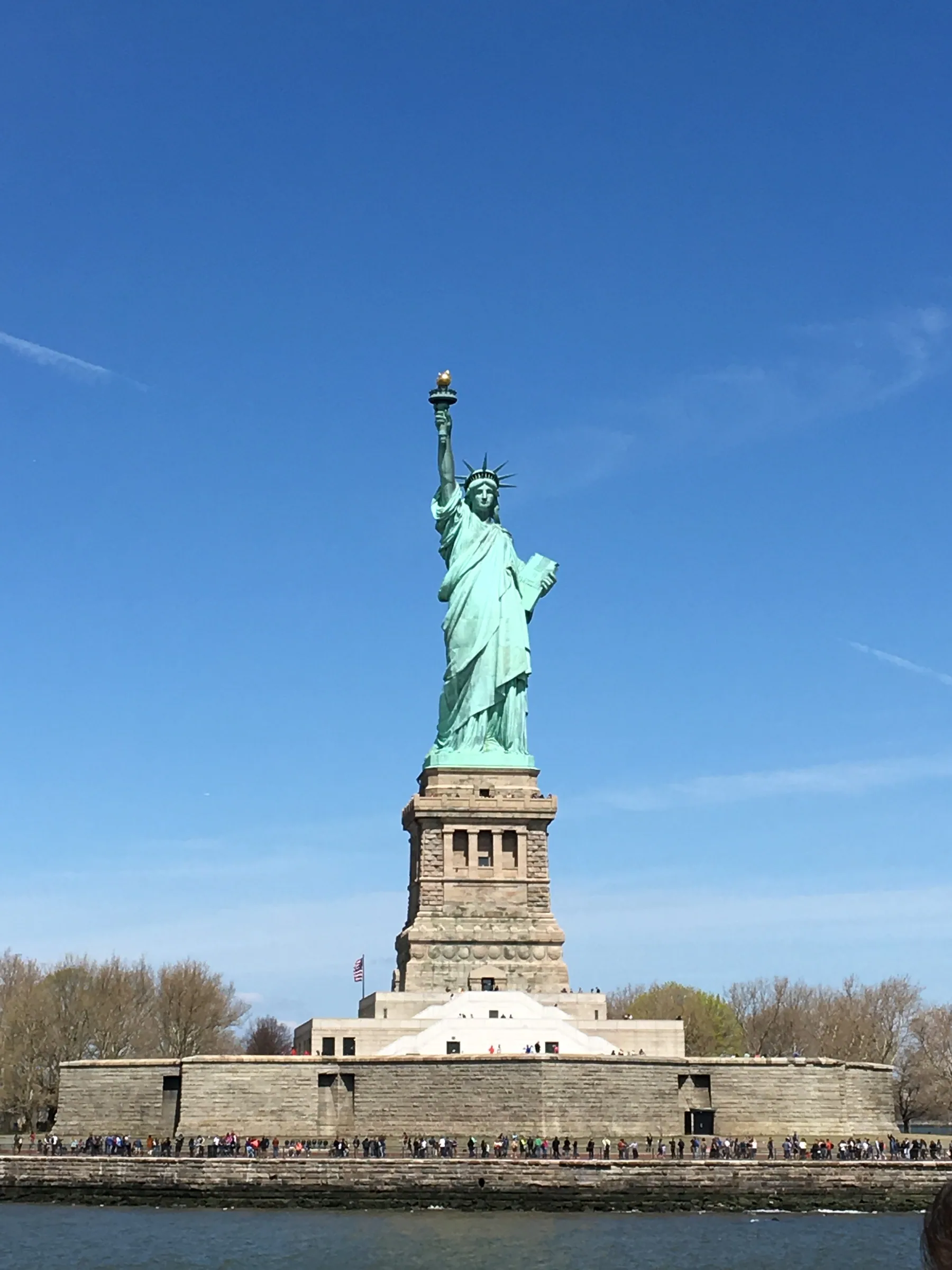
Then came the day’s main event: the Statue of Liberty, the ultimate American icon. A gift from France to the United States in the nineteenth century, the statue was dedicated in 1886. Over time, it became one of the defining symbols of both New York and the country—something almost everyone has seen, even if they have never visited the United States.
Honestly, I suspect some of the statue’s fame among my generation owes a little to the well-known game Command & Conquer: Red Alert. Plenty of young gamers probably first learned that America had a Statue of Liberty by blowing it up in the game.
The boat ride in both directions also gave us a view of the Manhattan skyline from the water.
We then arrived at Times Square, which seemed to be what happened when New York turned the crowds, tall buildings, and advertising all the way up at once. Enormous screens lit nearly the entire neighborhood, especially after dark.
It was packed. We had heard at the time that certain Times Square advertising slots, when purchased for only a very short run, were not as outrageously expensive as one might imagine. That apparently explained some of the wonderfully random things that occasionally appeared there.
On our third day, we visited the Metropolitan Museum of Art. The Met’s collections span much of the world and thousands of years of history, from ancient Egypt, Greece, and Rome to European painting and Asian art. It was far too large to examine seriously in a single day. With our breakneck approach to sightseeing, we could only pick a few things to see. Still, there seemed to be treasures of every imaginable kind.
After some more eating and wandering around New York, our visit came to an end.
A Las Vegas stop filled with casino resorts, a David Copperfield show, a deeply limited unlimited-drinks package, and a motion-sickness-inducing helicopter trip to the Grand Canyon.
Our next stop was Las Vegas.
Most of our time there was devoted to eating and drinking. We sampled buffet after buffet, watched show after show, and tried the gaming tables downstairs at our hotel. Both sides of the Las Vegas Strip were essentially one enormous entertainment complex, with each casino resort packing rooms, restaurants, gambling, and performances into a single building. For people like us, who had no serious plan, it was possible to spend an entire day without even going outside.
The show I remember best was David Copperfield’s. When I told the others about it, someone asked, “Was it really him?” I said, “I think so. Probably.”
At the time, I did not yet understand Las Vegas’s place in the entertainment world. I had no idea that so many major performers held long-running residencies there, so I genuinely was not sure whether we had seen Copperfield himself. I compared the man onstage with his photographs. Probably him.
The show was excellent and full of the enormous stage illusions for which Copperfield was known. Making a person appear would have seemed almost too small. The things turning up onstage included cars, motorcycles, and a dinosaur skeleton.
It also reminded me of something I had once heard: no magician could possibly perform for an entire career without making a mistake, so when something went wrong, the trick was to talk your way around it. I have no idea whether anything went wrong that night. There was, however, a great deal of talking.
That created a problem. My travel companions from China could not understand the English. What were they supposed to do?
I stepped in to provide live simultaneous misinterpretation. Yes—misinterpretation.
Unlike actual simultaneous interpretation, mine maintained only a loose and occasionally adversarial relationship with the source material. I simply could not keep up with Copperfield’s delivery, so the result came out in scattered fragments. I would translate the first sentence of background perfectly; he would then rattle through a long story; I would fall hopelessly behind and eventually offer this summary: “He just told a story that wasn’t very important.”
My companions still rated the show highly. Their reasoning was that magic remained watchable without understanding the dialogue, which beat staring blankly at a Broadway stage.
We also ate at plenty of buffets and tried several well-reviewed restaurants nearby. The largest trap we encountered was one buffet’s unlimited-alcohol package.
Unlike soft drinks, the alcohol had to be brought by a server. You could not pour it yourself, nor was there anywhere to do so. The server therefore became the system’s primary bottleneck.
The glasses were neither especially large nor especially small—perhaps 300 or 400 milliliters. For the northeastern Chinese contingent among us, that amount of beer was only a few mouthfuls.
What happened, then, was predictable. A beer arrived and vanished in two swallows. The server vanished too, and it might be another ten or fifteen minutes before the next refill. One of my companions grew extremely unhappy. Unable to express that in English, he picked up the glass and knocked its base against the table. The server responded with an irritated look and something roughly equivalent to, “I heard you. I’m busy.”
Wait, now you were unhappy too? The glass was empty, everyone’s patience was empty, and a prompt refill could at least have filled one of them.
Neither of the two understood what the other was saying. During a two-hour buffet, we probably managed only about five refills. And this was supposed to be unlimited drinking?
At this particular buffet, “unlimited” existed only in theory. In practice, the bottleneck reduced the throughput to something decidedly limited. I could not recommend paying for it.
Our only real excursion away from Las Vegas was to the nearby Grand Canyon. Driving there would have consumed far too much of our tight schedule, so we chose the quickest option available to us: a helicopter.
Helicopter trips from Las Vegas to the Grand Canyon were already a classic local excursion, flying directly over broad stretches of desert and canyon country. For an itinerary in which time was tighter than money, it looked entirely reasonable—on paper.
We booked a tour that promised hotel pickup, a helicopter flight to the Grand Canyon, time on the ground, and a flight back. It was extremely expensive.
The hotel pickup alone was enough to astonish me.
A stretch Lincoln pulled up for us. A man who looked rather like a butler stepped out and invited us aboard. Inside, the car felt like a living room, complete with a refrigerator and a table.
It was my first time in a car like that. One of my companions observed that this was Las Vegas: apparently, if you supplied enough money, Vegas supplied the spectacle.
Then I boarded the helicopter—my first helicopter ride in years.
The important thing was that I did not yet know helicopters made me airsick. I climbed aboard in great excitement and immediately began moving around and taking photographs of everything. After takeoff, I photographed Las Vegas through the window.
From above, the already extravagant hotels and casinos around the Strip suddenly became a small cluster of buildings in the desert. The gold-covered Trump building was undeniably gaudy, but also, somehow, a little cool.
Five minutes into the flight, I began to feel as though I might vomit. I remained dizzy for the entire trip, but somehow held on until we landed several dozen minutes later without throwing up inside the helicopter.
Here are the precious photographs I took at considerable risk of making myself sick.
It had looked enormous from the helicopter. Once we were actually on the ground, the scale became even more absurd.
It was spectacular. The Grand Canyon was, in fact, very grand. And unmistakably a canyon.
There was also the famous Grand Canyon Skywalk, a horseshoe-shaped glass bridge projecting from the canyon’s edge, with the canyon directly beneath your feet. In theory, it should have been thrilling. After the helicopter flight, however, I had very little capacity for additional thrills left.
Then we flew back. Once again, I very nearly threw up.
I learned my lesson. From then on, whenever I take a helicopter, my rule is to keep my head pressed firmly against the seat and minimize unnecessary movement, in the hope of keeping the airsickness to a minimum.
And with that, our Las Vegas visit came to an end.
Three packed days in Los Angeles, from Hollywood and Universal Studios to Beverly Hills and the Getty Center.
Our next stop was Los Angeles.
Los Angeles was enormous, and getting anywhere without a car was nearly impossible. Los Angeles traffic was another matter entirely, however, and none of us wanted to drive. In the end, we booked a three-day tour that included transportation. It was quite convenient. The city sprawls in every direction, and the distances between attractions can be absurd. For people who wanted to roam all over the place without personally doing battle with Los Angeles traffic, the tour solved the most difficult part of the trip.
On the first day, we began on the Hollywood Walk of Fame. There was no shortage of famous names. Looking down as we walked, we passed actors, singers, and directors we had previously known only from television and film, now embedded in the sidewalk beneath our feet.
Next came Madame Tussauds Hollywood. At that point, I had not yet visited Madame Tussauds in London. It was one of those famous places I had known from textbooks long before I ever saw one in person.
We secured several photographs with celebrities.
We then went to Universal Studios Hollywood. Beyond the rides, visitors could tour parts of Universal’s film and television production areas. To me at the time, it felt a little like suddenly stepping behind the scenes of a movie: sets, streets, and production facilities that I had previously seen only on a screen were now directly in front of me.
That brought the day to an end. It had been remarkably full.
Early the next morning, a bus took us straight to San Diego. It was essentially the San Diego expansion pack for our Los Angeles tour. That story belongs in the San Diego entry.
Our third day was devoted to a tour of Los Angeles itself. We began in Beverly Hills.
We toured the outskirts of Beverly Hills. At our level of celebrity, the outskirts were probably about as far as we were getting. We were told that many extremely wealthy people and celebrities lived there. Beverly Hills is one of the Los Angeles area’s best-known luxury residential districts, so our principal activity as tourists was to sit in the vehicle, look at the streets, mansions, and landscaping from outside, and imagine how the wealthy lived.
We then went to the Getty Center. After two days of classic Los Angeles entertainment, the tone of the trip suddenly became much quieter. In addition to its architecture and hilltop views, the Getty Center holds an extensive collection of European paintings, sculpture, and decorative arts. We saw several works by the Impressionist master Claude Monet.
Afterward, we walked through the Getty Center’s Central Garden. The garden is one of the center’s signature landscapes, with water flowing down toward a central pool and a large maze of clipped azaleas at its heart.
The azalea maze could probably trap a small squirrel.
And with that, our final day in Los Angeles came to an end.
A day trip from Los Angeles, with a cruise on San Diego Bay followed by an afternoon of animal shows and repeat rides at SeaWorld.
Early in the morning, we took a bus from Los Angeles to San Diego. On the way, our guide told us one of his more memorable stories.
According to him, border inspections from Mexico into the United States near San Diego were extremely strict, while checks in the other direction had once been far more relaxed. Sometimes, he said, vehicles were simply waved through without being checked at all. His explanation was that, under normal circumstances, no one was trying to sneak from the United States into Mexico.
Then, on one occasion, a tour-bus driver got lost and drove an entire busload of passengers straight into Mexico. Getting back was much more difficult: most of the people onboard, including the driver, had not even brought their passports. The whole bus suddenly found itself stranded in a deeply awkward situation.
The guide went on to say that the United States had gradually strengthened southbound checks. One reason, reportedly, was that fugitives really did use that route to escape into Mexico. By the time of our visit, he said, it had become much harder to repeat the legendary feat of accidentally driving an entire bus into Mexico.
We began with a harbor cruise, seeing San Diego Bay from the water and passing the Coronado Bridge along the way. The scenery was excellent.
We then went to SeaWorld San Diego. It combined marine-animal exhibits and performances with amusement rides, making it roughly equal parts marine park and theme park.
We first walked through the animal exhibits.
To be honest, judged purely as an aquarium, the variety of species was not particularly impressive.
We then watched the killer whales—or orcas—perform.
The name “killer whale” suddenly sounded rather less theoretical. According to our guide, SeaWorld had experienced serious incidents involving trainer injuries and deaths in the past. San Diego had also seen an incident in which an orca bit a trainer during a performance and dragged the trainer underwater. The whale shows had also drawn sustained criticism from animal-welfare groups. At the time, I wondered how much longer this kind of performance would continue. Since we were already there, we watched while we still could.
Looking back, 2016 happened to be a major turning point for SeaWorld’s orca program. A little over a month before our visit, the company had announced that it would end orca breeding and that the whales already in its parks would be the final generation. In the years that followed, its traditional entertainment-focused orca shows also gradually shifted toward presentations emphasizing animal behavior and education.
There was also a seal show.
And then came that staple of almost every aquarium: a dolphin show.
By the time the shows ended, it was nearly time to head home. Then we found a water ride in the park.
There was no line at all. We rode it, got off, immediately climbed back on, and repeated the process several times—the sort of treatment one rarely receives at a crowded amusement park.
That evening, we took the bus back to Los Angeles, bringing our San Diego day trip to an end.